
AI Agent token issuance craze: Seize the future trend of tokenization

Original title: Random Sunday Thoughts on What Comes After Agent Tokenization?
Original author: Defi0xJeff, Crypto Kol
Original translation: zhouzhou, BlockBeats
Editor's note:This article discusses the trend of tokenization and its future development, covering the progress of tokenization in the fields of assets, art, income, AI agents, etc., introducing how the pioneers of various tokenizations drive industry changes, and explores possible tokenization trends in the future, including the tokenization of data, attention, and AI applications. Tokenization is not only a technological innovation, but also a force that changes people's interactions and creates new opportunities.
The following is the original content (the original content has been reorganized for easier reading and understanding):
The concept of tokenization has always fascinated me. It seems simple, but whenever something new is tokenized, everyone's attention quickly turns to it.
Here’s a summary of some of the tokenization trends we’ve seen so far, how they’ve developed, and what might happen in the future:
Tokenization of Assets
The original tokenization trend.
Bitcoin paved the way for digital representation of assets by creating the first decentralized, secure, and transparent ledger system. Then, the advent of Ethereum in 2015 introduced smart contracts, making assets programmable — whether it’s real estate, art, or DeFi.
Today, Ethereum’s market value is $470 billion, and that’s the impact that tokenization has had on assets.
Tokenization of Art (NFTs)
The rise of NFTs introduced tokenization to the art world.
In 2017, projects like CryptoPunks and CryptoKitties brought NFTs into the public eye. By 2021, NFTs had reached $13 billion in trading volume, becoming the preferred way to represent digital art and collectibles. Many collectibles like CryptoPunks, BAYC, Art Blocks, and others were priced in the millions of dollars at their peak in 2021.
Tokenization of Yield
Another major change is the tokenization of yield.
Pendle fi pioneered the concept of tokenizing future yields in 2021. It created a market that allowed the trading of fixed and variable yields, adding flexibility and liquidity to DeFi. Pendle began to grow rapidly in 2023, especially in the LST (Liquid Staking Token) and the Points market in early 2024.
Today, $PENDLE has a market cap of $1.6 billion.

Tokenization of AI Agents
Now, we are seeing the tokenization of AI agents.
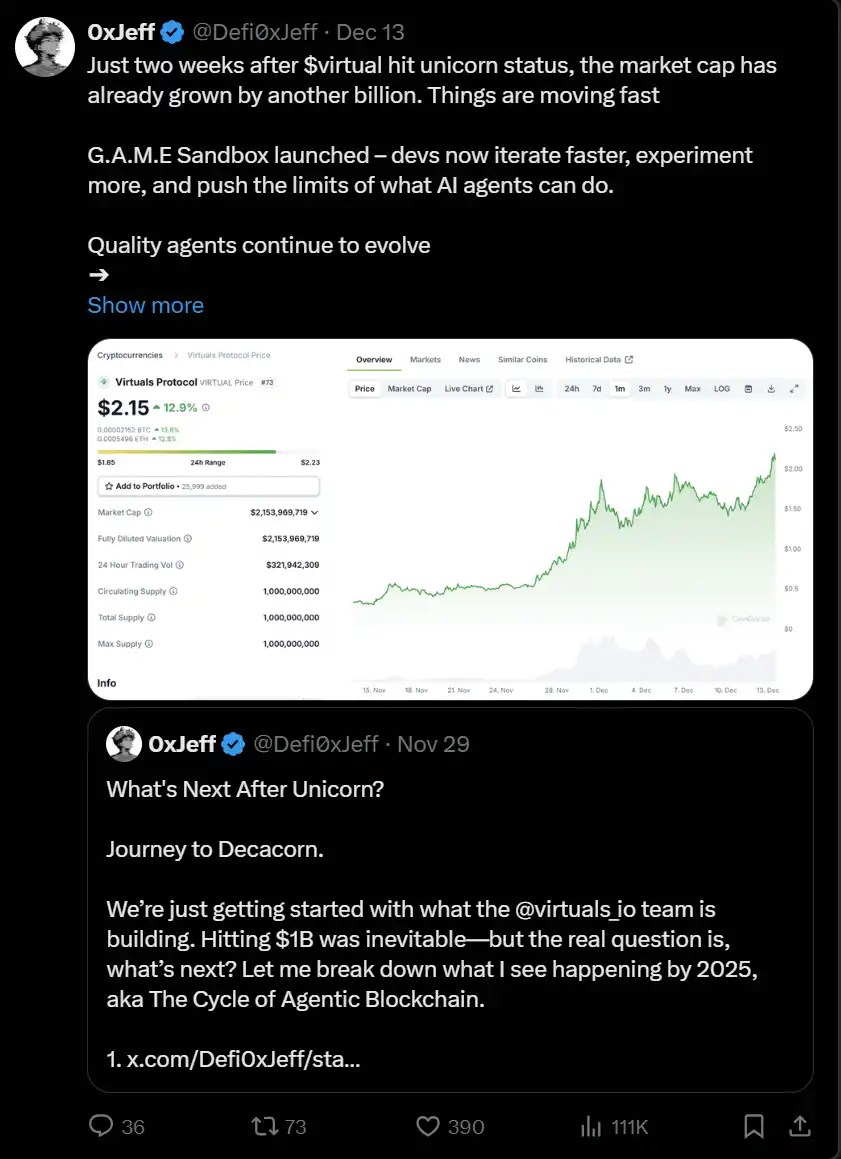
Virtuals io launched a platform where users can create AI agents and tokenize them, effectively funding their development costs.
The concept of AI agents began in October 2024, with Virtuals creating a market for agent ownership. Today, $VIRTUAL has a market cap of $2.5 billion.
What is the next big trend in tokenization?
Across these sectors — assets, art, yield, AI agents — we can see a clear pattern: pioneers in each space typically experience rapid adoption and significant price volatility.
Here are some ideas I’m watching:
Tokenization of Data
withvana is exploring DataDAOs and Data Liquidity Pools (DLPs).
Users can contribute data to these pools, maintain data ownership, and be rewarded based on the quality of their contributions.
Essentially, it turns data into a liquid, tradable asset.
$VANA went live on December 16th, and the concept of tokenized data ownership could be huge.
Tokenization of Attention
kaitoai is working on tokenizing attention in Web3, and they’ve demonstrated the ability to generate and facilitate more attention through their platform, the Mindshare dashboard, and most recently, the Yap-to-Earn feature.
Their Yapper leaderboard incentivizes thought leaders to speak out more, earn Yap points, and ultimately receive airdropped $KAITO tokens.
Basically, Yap = Attention = $KAITO. This is an interesting way to show how Web3 is redefining user engagement.
Tokenization of AI Applications
This looks like a natural extension of the AI agent trend.
With the rise of tools like Replit and an agent ecosystem, we are getting closer to personalized software creation.
Tokenized AI applications allow users to initiate development and own a share of the revenue generated by the application.
Competitors in the space include alchemistAIapp and myshell ai, both of which enable creators to build revenue-generating AI applications that provide real and scalable use cases.
Myshell goes a step further by allowing investors to invest directly in these applications and receive a share of the revenue generated by the applications in the future. This model not only supports development, but also aligns the interests of creators and investors.
Final Thoughts
Tokenization trends always bring new waves of innovation and adoption, but what’s exciting about them is not just the technology itself - it’s how they bring people together and turn the focus to new opportunities.
You may also like

Hyperliquid has stirred up Wall Street, with regulations uncertain and market makers fleeing first?

When Hyperliquid takes away Solana's "internet capital market" script

Base native leveraged prediction market OmenX officially launches on the mainnet

WEEX Labs Co-Hosts ETHMilan 26 Openguin Party: Rooftop AI Trading Calling

Best Crypto Staking Platforms 2026: Is XRP Staking Really Worth It?
Circle: From Issuance to Infrastructure

Capital Markets: How will independent agents obtain financing?

Morning News | AEON completes $8 million Pre-Seed round financing led by YZi Labs; Goldman Sachs liquidates XRP and Solana ETF holdings in Q1; Strategy increased its holdings by 24,869 BTC last week

Cross-border payment giant Wise lands on Nasdaq

a16z Crypto: How should crypto entrepreneurs understand the CLARITY Act?

Hyperliquid has been sued by two major traditional exchanges

Dialogue with Lead Bank Founder Jackie: American Banks Re-embrace Crypto
Vitalik: What we need to do is not to fight against AI, but to create a sanctuary

Morning News | VanEck and Grayscale submitted BNB ETF amendments on the same day; BlackRock discusses investing billions of dollars in SpaceX's IPO; Michael Saylor releases Bitcoin Tracker information again

Crypto ETF Weekly | Last week, the net outflow of Bitcoin spot ETFs in the United States was $995 million; the net outflow of Ethereum spot ETFs in the United States was $255 million

This Week's News Preview | The Federal Reserve Releases the Last FOMC Minutes of the "Powell Era"

The ambition of "one account trading global assets": How does CoinUp.io break down asset barriers to become an industry dark horse?
How long will it take for the GPU futures market when computing power is commoditized?
Hyperliquid has stirred up Wall Street, with regulations uncertain and market makers fleeing first?
When Hyperliquid takes away Solana's "internet capital market" script
Base native leveraged prediction market OmenX officially launches on the mainnet
WEEX Labs Co-Hosts ETHMilan 26 Openguin Party: Rooftop AI Trading Calling
Best Crypto Staking Platforms 2026: Is XRP Staking Really Worth It?
Circle: From Issuance to Infrastructure


