
- Buy Crypto
- Markets
 Futures
- Spot
- Copy Trade
- Earn
- More
AI's Hidden Power: Former Google CEO Says We're All Missing the Point
By: cryptonews|2025/05/16 06:00:15
0
Share
Eric Schmidt doesn't believe the AI hype. In fact, he thinks AI isn’t hyped enough. Speaking in a recent TED talk, the former Google CEO argued that while most people fixate on AI's language skills, they're completely missing its rapidly advancing planning and strategy abilities—capabilities that could reshape society entirely. "Most of you think of AI—I'll just use the general term—as ChatGPT," Schmidt said during his talk. "This was two years ago. Since then, the gains in what is called reinforcement learning, which is what AlphaGo helped invent, allow us to do planning." Schmidt's view comes at a time when public fascination with AI remains basically squarely focused on text generation. But he insists that AI's trajectory extends far beyond writing clever emails or summarizing documents, helping increase our productivity on many levels.. "You're seeing the arrival, the shift from language to language. Then you had language to sequence, which is how biology is done. Now you're doing essentially planning and strategy," Schmidt explained. "The eventual state of this is the computers running all business processes." The economic impact could be huge—Schmidt claims up to 30% per day when AI agents are globally adopted—but he pinky promised we mere mortals will still have some use. "Humans are unchanged in the midst of this incredible discovery. Do you really think that we're going to get rid of lawyers? No, they're just going to have more sophisticated lawsuits. Do you really think we're going to get rid of politicians? No, they'll just have more platforms to mislead you," he quipped. More do, less talk While most consumers marvel at chatbots, Schmidt pointed to systems like OpenAI's o3 and Deepseek R1 that demonstrate sophisticated planning abilities—going "forward and back, forward and back" to work through complex problems. These reasoning models and research agents can play a big role in major financial decisions. For example, he explained how he’s using AI to learn more about the space industry now that he has heavy investments in the field. “In my case I bought a rocket company because it was interesting, and it's an area that I'm not an expert in and I want to be an expert, so I'm using deep research and these systems are spending 15 minutes writing these deep papers,” he explained. “It's extraordinary.” Schmidt's view mirrors that of other AI experts who have raised similar concerns about the public's narrow focus on language models. Yann LeCun, chief AI scientist at Meta, has repeatedly stated that current large language models lack essential capabilities such as understanding the physical world, persistent memory, reasoning, and planning. LeCun, however, predicted earlier this year that a "new paradigm of AI architectures" would emerge within five years, with a stronger emphasis on planning and reasoning capabilities. His proposed Hierarchical Joint Embedding Predictive Architecture (H-JEPA) aims to enable AI to plan sequences of actions to optimize objectives. The difference between current chatbots and truly intelligent systems, experts suggest, lies in planning—the ability to map out a strategy, anticipate consequences, and adjust accordingly. Beyond technical challenges, Schmidt frames AI development as a high-stakes competition between the United States and China—one with potential to trigger global conflict. "The competition between the West, particularly the United States, and China is going to be defining in this area," Schmidt said. The race has already begun to reshape global trade, with an ongoing tariff war started by U.S. President Donald Trump affecting critical supply chains. Besides tariffs, the U.S. restrictions on China's access to advanced chips, has pushed Chinese researchers toward algorithmic efficiency and betting on local technology that America has already tried to prevent other countries from using. Schmidt insists this is an actual problem that’s already taking a pivotal presence in war rooms. "These conversations are occurring around nuclear opponents today in our world. There are legitimate people saying the only solution to this problem is preemption," he claimed. "The foreign policy people have not thought about this. And this is coming (...) probably in 5 years." Dreams Amid Dangers Despite these grave concerns, Schmidt maintains cautious optimism about AI's potential benefits. In education, Schmidt envisions personalized AI tutors for every person on Earth. He also argued that healthcare, physics, materials science, all stand to benefit from AI's analytical powers, and he urged everyone to adopt the technology to stay relevant. "My advice to you all is ride the wave, but ride it every day. Don't view it as episodic." As a good old tech CEO, the former Google chief urged everyone to adopt AI. "Each and every one of you has a reason to use this technology. If you're an artist, a teacher, a physician, a business person, a technical person—if you're not using this technology, you're not going to be relevant compared to your peer groups and your competitors." And just like OpenAI once equated its product to life-changing inventions like the wheel, and the fire, Schmidt assured there won’t be anything as important as AI in the next thousand years. "The arrival of this intelligence, both at the AI level, the AGI, which is general intelligence, and then super intelligence, is the most important thing that's going to happen in about 500 years, maybe a thousand years, in human society. And it's happening in our lifetime," he assured.
You may also like

Pantera Capital: How has Crypto as a Service affected us?
If you are planning to start a business in 2026, my advice is simple: Instead of just talking about technology, focus more on how you can solve real-world problems.

Pantera Capital: What changes have we made when crypto is treated as a service?
If you are planning to start a business in 2026, my advice is simple: stop talking excessively about technology and focus more on the actual problems you can solve.
Wall Street Shorts ETH: Vitalik is aware and has front-run, while Tom Lee remains oblivious
"The Ethereum token economic model has collapsed, wake up and see this clearly."

Social Capital CEO: How Equity Tokenization is Reshaping Capital Markets from US Stocks to SpaceX?
Equity tokens represent the next challenge: can tokenization expand from payments to ownership of financial assets?

CoinGecko Report: Surge of 346% vs Dip of 20.8%, The Wild Rise of DEX
A large-scale capital migration driven by platforms such as Hyperliquid towards decentralized infrastructure from centralization.

a16z: The Real Opportunity of Stablecoins Lies Not in Disruption but in Filling Gaps
The opportunity for stablecoins lies with those merchants that have yet to emerge.

Mining Exodus: Someone Holds $12.8 Billion AI Order
Mining Farms are Turning to AI Hashpower with no Turning Back.

March 6 Market Key Intelligence, How Much Did You Miss?
1. On-chain Funds: $16.3M USD has flowed into the OP Mainnet today; $13.7M USD has flowed out of Arbitrum
2. Largest Price Swings: $XPT, $AIX
3. Top News: Vitalik Calls on Ethereum Community to Shift Mindset, Uphold Core Principles, and Rethink Application Design "From Scratch"

a16z: The True Opportunity of Stablecoins is in Complementing, Not Disrupting
The stablecoin opportunity lies with those merchants yet to come onboard.

Predict LALIGA Matches, Shoot Daily & Win BTC, USDT and WXT on WEEX
The WEEX × LALIGA campaign brought together football excitement and crypto participation through a dynamic interactive experience. During the event, users predicted matches, completed trading tasks, and took daily shots to compete for rewards including BTC, USDT, WXT, and exclusive prizes.

Ray Dalio Dialogue: Why I'm Betting on Gold and Not Bitcoin
Gold is the only asset with a long-term history that can be transferred, is not easily replicable, and does not rely on anyone else's promise. Most currencies, debts, stocks, etc., are just promises of someone honoring their purchasing power.

Who Took the Money in the AI Era? A Must-See Investment Checklist for HALO Asset Trading
A one-page paper listed a series of questions about the potential impact of AI progress. Looking back over two years later, these questions appear particularly prescient, although none of them provided a definitive answer at the time.
Wall Street Bears Target Ethereum: Vitalik In the Know Takes Flight, Tom Lee Remains Bullish
「The Ethereum Tokenomics Has Collapsed, Wake Up and Realize It」
Pump.fun Hacker Steals $2 Million, Receives 6-Year Prison Sentence, Opts for 'Self-Detonation'
Life of Talent, Paranoia, and Setbacks

6% Annual Percentage Yield as Musk Declares War on Traditional Banks
A black metal card, 600x rate delta.
36 years, 4 wars, 1 script: How does capital price the world in conflict?
When the cannon fires, 10,000 ounces of gold. In a turbulent era, the wealth choice of the common people.

Mining Companies' Great Migration: Some Have Already Secured $12.8 Billion in AI Orders
Mining companies turn to AI computing power, with no turning back.
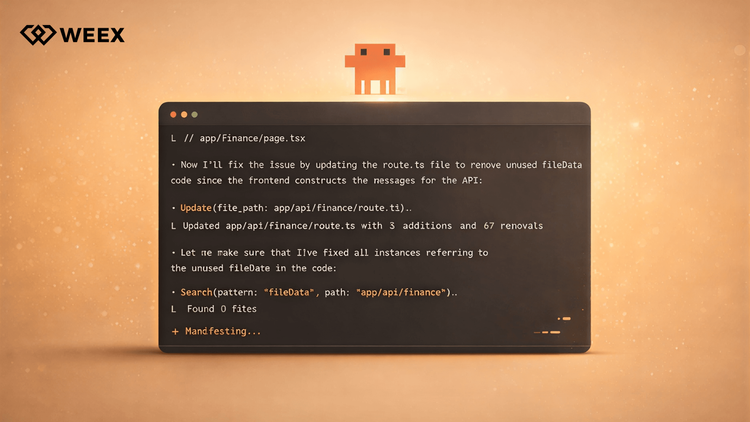
What Is Vibe Coding? How AI Is Changing Web3 & Crypto Development
What is vibe coding? Learn how AI coding tools are lowering the barrier to Web3 development and enabling anyone to build crypto applications.
Pantera Capital: How has Crypto as a Service affected us?
If you are planning to start a business in 2026, my advice is simple: Instead of just talking about technology, focus more on how you can solve real-world problems.
Pantera Capital: What changes have we made when crypto is treated as a service?
If you are planning to start a business in 2026, my advice is simple: stop talking excessively about technology and focus more on the actual problems you can solve.
Wall Street Shorts ETH: Vitalik is aware and has front-run, while Tom Lee remains oblivious
"The Ethereum token economic model has collapsed, wake up and see this clearly."
Social Capital CEO: How Equity Tokenization is Reshaping Capital Markets from US Stocks to SpaceX?
Equity tokens represent the next challenge: can tokenization expand from payments to ownership of financial assets?
CoinGecko Report: Surge of 346% vs Dip of 20.8%, The Wild Rise of DEX
A large-scale capital migration driven by platforms such as Hyperliquid towards decentralized infrastructure from centralization.
a16z: The Real Opportunity of Stablecoins Lies Not in Disruption but in Filling Gaps
The opportunity for stablecoins lies with those merchants that have yet to emerge.


 App
App