
- Buy Crypto
- Markets
 Futures
- Spot
- Copy Trade
- Earn
- More
Bitcoin Core Ditches OP_RETURN Byte Cap, Stirring Debate on Network Modernisation
By: crypto news australia|2025/05/08 11:30:02
0
Share
Bitcoin Core’s new update removes the 80-byte limit on OP_RETURN, allowing more data and multiple OP_RETURN outputs per transaction—modernising the protocol to match real-world mining behavior.The change reignites discussion about OP_CAT, a disabled opcode that, if revived, could bring powerful smart contract capabilities like covenants, ZKPs, and decentralised bridges to Bitcoin.Critics argue the update breaks Bitcoin’s minimalist ethos and lacks community consensus, with figures like Luke Dashjr and Samson Mow warning it may bloat blocks and increase attack surfaces.Bitcoin Core is shaking things up again, sparking intense debate by ditching its longstanding 80-byte OP_RETURN limit. The upcoming update effectively kills the old ceiling, a move framed as aligning Bitcoin Core policy closer to real-world mining practices, but not everyone is thrilled.The change was announced by developer Greg Sanders on GitHub, stating that it will allow transactions with OP_RETURN outputs exceeding 80 bytes as well as multiple such outputs per transaction. In plain terms: more data, fewer artificial restrictions, and a relay policy that finally mirrors on-chain reality. The long-standing cap, originally a gentle signal that block space should be used sparingly for non-payment proof of publication data, has outlived its utility. Greg Sanders Before we get into the details, let’s have a quick rundown on what this all means.Related: Crypto Industry Urges Albanese Government to Fast-Track Digital Asset LawsOP_RETURN or OP_CAT?OP_RETURN and OP_CAT are two Bitcoin script commands—one embedded, one exiled—that define the boundary between Bitcoin’s past limitations and its potential future.Originally introduced as a way to embed small, unspendable pieces of data into the blockchain, OP_RETURN allows up to 80 bytes of user-defined data per transaction. The catch is that it burns the Bitcoin sent with it. That output is forever unspendable, a calculated tradeoff for preventing UTXO bloat.Its use cases are narrow but persistent. It’s useful for things like proving a document existed at a certain time, creating basic tokens, or adding notes. And because it’s clearly unspendable, it doesn’t make the system slower or more complicated. But Bitcoin only lets one OP_RETURN note per transaction under normal conditions—so you can’t abuse it to spam the network.OP_CAT, on the other hand, is the opcode that never really was. OP_CAT is a Bitcoin opcode that was disabled in 2010 because it could potentially crash nodes. All it does is combine two pieces of data from the stack into one. Sounds basic, right? But it’s actually very powerful.If reactivated, OP_CAT would allow Bitcoin to support much more advanced smart contracts, opening the door to an entirely new class of smart contracts on the network —more composable, flexible, and modular. Think covenants, advanced multi-sigs, zero-knowledge proofs (ZKPs), or even decentralised bridges, etc.Criticism and ControversyThe backlash was swift and sharp. Luke Dashjr, leading the alternative Bitcoin Knots client with around 5% network presence, slammed the move as “utter insanity”, asserting it betrays Bitcoin’s minimalist principles. Samson Mow called it an “undesirable change” on X, but stated there might be pragmatic reasons for it, adding that users can simply stick to version 29.0 or switch to alternative clients if they reject the new policy.“There is no consensus at the moment on this OP_RETURN issue,” said Marty Bent, managing partner at Ten31 Fund. Critics also took aim at the rollout process itself, saying the proposal lacked proper consensus.Related: Trump Dodges Questions on Memecoin Profits Amid Price PlungeBitcoin recently reclaimed US$97.5K (AU$151K), a change of over 20% in the last 30 days. The surge comes as the trade war tensions between China and the US seem to calm down, and US states like New Hampshire break ground by becoming the first to adopt a BTC reserve.The post Bitcoin Core Ditches OP_RETURN Byte Cap, Stirring Debate on Network Modernisation appeared first on Crypto News Australia.
You may also like

Particle Founder: The entrepreneurial insights I have gained the most from in the past year
Stop lean startup, stop lightning entrepreneurship, and think carefully about what your product aspirations are.

Huang Renxun's latest podcast transcript: The future of Nvidia, the development of embodied intelligence and agents, the explosion of inference demand, and the public relations crisis of artificial intelligence
The competition in the future is not just about whose model is larger or whose computing power is stronger, but also about who understands the industry better, who can embed AI more deeply into real processes, and who can organize these capabilities into a runnable and scalable system.

OKX Ventures Research Report: AI Agent Economic Infrastructure Research Report (Part 1)
The existing infrastructure is hostile to the Agent economy. Agents can think and act independently at the "capability level," but at the "economic level," they are still locked into infrastructure designed for humans.

The migration of settlement rights: B18 and the institutional starting point of on-chain banks
In the traditional system, banks decide the settlement; in the on-chain system, code begins to take over this responsibility.

From Tencent and Circle: Looking at the Simple and Difficult Questions of Investment
The AI narrative continues to ferment, but the recent performance of related stocks varies, with some in the midst of summer and others as if in winter.

The second half of stablecoins no longer belongs to the crypto circle
What Coinbase doesn't want, Mastercard is eager to buy.

Cursor "Shell" Kimi Controversy Reversed: From Copyright Infringement Allegations to Authorized Collaboration, China's Open Source Model Once Again Becomes a Global AI Foundation
Cursor was accused of being based on Kimi K2.5, which sparked controversy, and was later confirmed to be compliant through Fireworks AI due diligence.

The Real Reason Tokens Don't Sell: 90% of Crypto Projects Overlook Investor Relations
Provide an Investor Relations Best Practices Guide for Crypto Projects.

Is the income of pump.fun real, earning a million dollars a day despite the market downturn?
If it can really earn this much, what is the reason for the low price of $PUMP?

The real reason why tokens are not selling: 90% of crypto projects neglect investor relations
Investor Relations Practice Guide for Cryptocurrency Projects.

Who is the true winner of the "Tokenization" narrative?
Virtually everyone benefits, but the reason for the benefit, the timing, and the underlying logic are completely different.

Moss: The Era of AI-Traded by Anyone | Project Introduction
AI Trading Agent is rapidly growing its infrastructure.

Chip Smuggling Case Exposes Regulatory Loophole | Rewire News Evening Update
AI chips have become a strategic asset more sensitive than missiles

How a Structured AI Crypto Trading Bot Won at the WEEX Hackathon
Ritmex demonstrates how disciplined risk control and structured signals can make an AI crypto trading bot more stable and reliable on WEEX, highlighting the importance of combining execution discipline with scalable AI trading systems.

Old Indicator Fails, Three Major New Signals Emerge: BTC True Bottom May Still Be Below $60K
When the grocery shopping auntie on the subway, or Tony the hairdresser, start asking you about BTC, crypto, and cryptocurrency investments, selling immediately will be the only best option.

Meeting OpenClaw Founder at a Hackathon: What Else Can Lobsters Do?
Imperial College London MetaGame: AI Agent × Web3 Landing Three Major Directions.
Huang Renxun's Latest Podcast Transcript: NVIDIA's Future, Embodied Intelligence and Agent Development, Soaring Demand for Inferencing, and AI's PR Crisis
The future of competition is not only about whose model is bigger, whose computing power is stronger, but also about who understands the industry better, who can more deeply integrate AI into real processes, and who can organize these capabilities into a set of executable, scalable systems
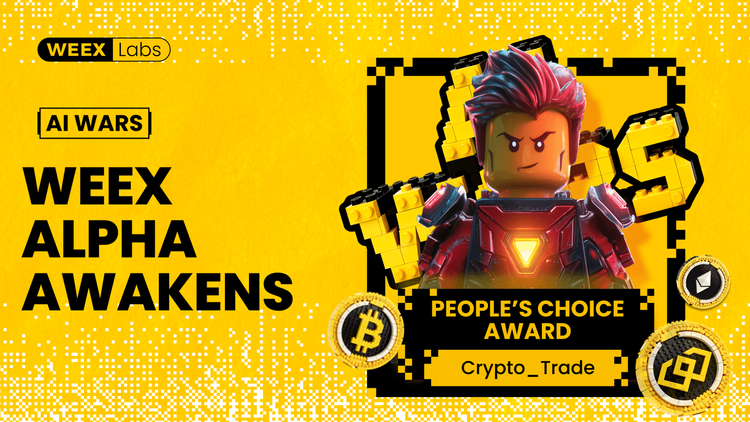
How a Structured AI Crypto Trading Bot Won at the WEEX Hackathon
Crypto_Trade shows how structured inputs and controlled adaptability can build a more stable and reliable AI crypto trading bot within the WEEX AI Trading Hackathon, highlighting a practical path toward scalable AI trading systems.
Particle Founder: The entrepreneurial insights I have gained the most from in the past year
Stop lean startup, stop lightning entrepreneurship, and think carefully about what your product aspirations are.
Huang Renxun's latest podcast transcript: The future of Nvidia, the development of embodied intelligence and agents, the explosion of inference demand, and the public relations crisis of artificial intelligence
The competition in the future is not just about whose model is larger or whose computing power is stronger, but also about who understands the industry better, who can embed AI more deeply into real processes, and who can organize these capabilities into a runnable and scalable system.
OKX Ventures Research Report: AI Agent Economic Infrastructure Research Report (Part 1)
The existing infrastructure is hostile to the Agent economy. Agents can think and act independently at the "capability level," but at the "economic level," they are still locked into infrastructure designed for humans.
The migration of settlement rights: B18 and the institutional starting point of on-chain banks
In the traditional system, banks decide the settlement; in the on-chain system, code begins to take over this responsibility.
From Tencent and Circle: Looking at the Simple and Difficult Questions of Investment
The AI narrative continues to ferment, but the recent performance of related stocks varies, with some in the midst of summer and others as if in winter.
The second half of stablecoins no longer belongs to the crypto circle
What Coinbase doesn't want, Mastercard is eager to buy.


 App
App