
Blockchain Top Three Showdown: MegaETH, Hyperliquid, and Monad - Who Will Lead the Future?


Original Article Title: MegaETH vs Monad vs Hyperliquid: Who Leads in Instant Blockchain Transactions?
Original Author: threesigmaxyz, Blockchain Engineering and Audit Firm
Original Translation: zhouzhou, BlockBeats
Editor's Note: This article provides an in-depth analysis of the characteristics and competitive advantages of the three major blockchain platforms MegaETH, Hyperliquid, and Monad, exploring their performance in low latency, high throughput, decentralization, and more. Each platform has demonstrated unique value in specific use cases, providing developers and enterprises with different choices. With the continuous development of blockchain technology, these platforms have driven industry innovation and may facilitate more breakthroughs in the future through cross-ecosystem integration.
The following is the original content (reorganized for better readability):
The next big showdown in blockchain is here — MegaETH, Hyperliquid, or Monad?
In the rapidly evolving blockchain space, instant transactions are shifting from a luxury to a necessity. As decentralized finance applications, payments, gaming, and high-frequency trading continue to challenge the traditional blockchain's capacity, the demand for real-time performance is more urgent than ever. In this race, MegaETH, Monad, and Hyperliquid are vying to redefine the dominant position in transaction speed and scalability.
As mentioned in our previous article, MegaETH is an emerging Layer 2 solution designed with real-time performance at its core, garnering widespread attention with its nearly instant block times and high transaction throughput.
However, Hyperliquid and Monad have also established strong competitiveness through their unique blockchain performance optimization approaches. This article will delve into the advantages, architectures, and trade-offs of these solutions to understand who may be one step ahead in the race for instant blockchain transactions.

MegaETH Overview
MegaETH Labs is a Layer 2 scaling solution designed specifically for Ethereum. MegaETH stands out for its focus on real-time blockchain performance, providing ultra-low latency and high scalability support for applications that require instant responsiveness.
Latency and Speed: MegaETH has a block time ranging from 1 to 10 milliseconds, capable of processing up to 100,000 transactions per second (TPS).
Dedicated Nodes: Employing a core model with a sequencer, nodes are divided into sequencers, attestors, and full nodes, optimizing execution flow and reducing redundancy.
Integrated EigenDA: Leveraging EigenDA to provide data availability, ensuring reliability and performance while achieving scalability.
Advantages
MegaETH's architecture is designed for speed and efficiency, excelling in the competitive Layer 2 space:
Low Latency: Its near-instant transaction processing capability is ideal for high-frequency trading, gaming, and payment systems.
High Scalability: By processing blocks in milliseconds, it avoids the congestion issues common in other L2 solutions during peak times.
EVM Compatibility: Fully compatible with the Ethereum ecosystem, seamlessly integrating existing dApps while ensuring security.
While MegaETH focuses on real-time performance, it faces fierce competition from Hyperliquid and Monad. These two platforms have adopted radically different strategies in optimizing blockchain transactions.
Hyperliquid Overview
HyperliquidX is a fully on-chain perpetual contract trading protocol running on its proprietary Layer 1 blockchain, optimized for low latency and high throughput. By integrating spot, derivatives, and pre-listed markets, Hyperliquid introduces the high-performance consensus mechanism HyperBFT and plans to introduce HyperEVM to efficiently aggregate liquidity to expand its ecosystem.
Hyperliquid aims to redefine the trading experience through high-speed decentralized market infrastructure, making it highly attractive to financial institutions and high-volume traders. Its unique blend of spot and perpetual markets achieves seamless liquidity aggregation and rapid settlement.
Technical Advantages:
The Hyperliquid technology stack covers a broader range of financial primitives such as lending, governance, and native stablecoins.
Based on the HyperBFT consensus mechanism, it achieves a 0.2-second block time, maintaining a consistent state across all components to ensure performance, liquidity, and programmability.
With over 262,000 users and processing 200,000 transactions per second, it has established its leading position in decentralized market infrastructure.
To further expand its impact, Hyperliquid offers the Builder Codes feature, allowing other dApps and centralized exchanges (CEX) to seamlessly integrate their liquidity without paying transaction fees per trade. Builder Codes not only expand Hyperliquid's reach but also incentivize external platforms to leverage its high-performance transaction infrastructure, enhancing liquidity and expanding the network effect.

Monad Overview
Monad xyz has redesigned the EVM architecture, achieving unprecedented throughput through parallel execution. By addressing the limitations of Ethereum's sequential transaction processing, Monad enhances efficiency and scalability.
Monad aims to provide cutting-edge blockchain performance while maintaining decentralization, setting a new standard for Layer 1 scalability. Monad's architecture supports parallel transaction processing of multiple EVM instances, seamlessly integrating with existing user and developer workflows. Monad remains fully compatible with Ethereum bytecode while enhancing performance through advanced internal optimizations, preserving the development experience.
Technical Highlights:
Pipeline Optimization: Optimizes transaction execution, consensus processes, and state synchronization to maximize hardware efficiency and reduce latency.
MonadBFT Consensus Mechanism: Custom consensus mechanism based on HotStuff, supporting a decentralized validator set to achieve fast block finality.
MonadDB: A database designed for Ethereum state access, combined with optimistic parallel execution to achieve high throughput with minimal overhead.
Consensus and Execution Separation: Enhances scalability, supporting high-performance and low-latency application development.
Monad provides enterprise-level application support, offering tools for developers to create high-throughput, Ethereum-compatible decentralized applications.
Comprehensive Comparison

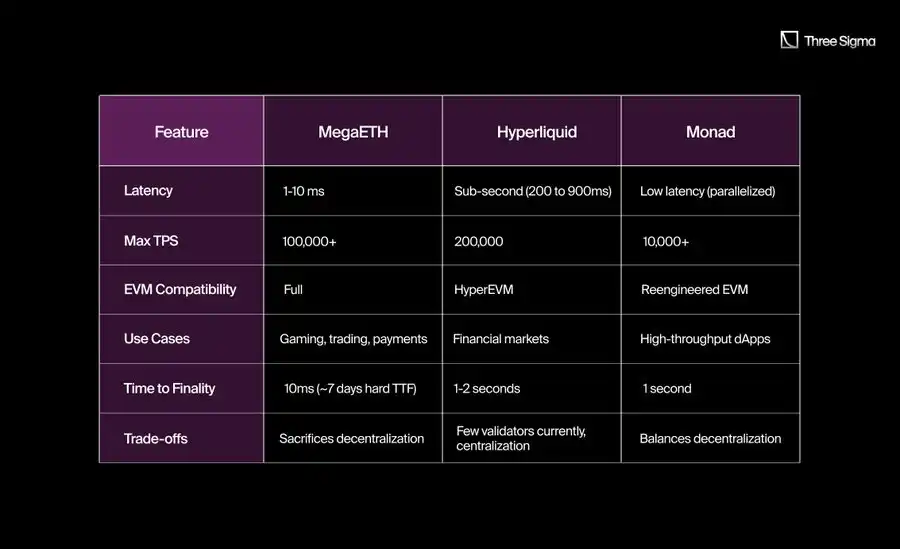
Evaluate the performance of MegaETH, Hyperliquid, and Monad on key metrics to gain a comprehensive understanding of their unique strengths and trade-offs. This comparison focuses on the following indicators: Latency, Throughput (TPS), EVM Compatibility, Use Cases, Time to Finality (TTF), and the trade-off between decentralization. These features highlight the core requirements for scaling blockchain infrastructure, ensuring real-world applications, and performance.
Latency
MegaETH: Excels in ultra-low latency (1-10 milliseconds) in Layer 2 transactions, suitable for applications requiring near real-time responsiveness, such as high-frequency trading or competitive gaming.
Hyperliquid: Optimized for sub-second latency, designed for financial markets to provide fast order execution and a seamless trading experience.
Monad: Through parallelized low-latency execution, maintains consistent performance even under high network loads, supporting diverse decentralized applications (dApps). The team has not specified the latency time.
Throughput (TPS)
MegaETH: Achieves throughput of over 100,000 TPS, focusing on scalability for large-scale applications.
Hyperliquid: With its proprietary HyperBFT consensus mechanism and Layer 1 optimization, achieves a TPS of 200,000.
Monad: Maximum throughput is 10,000 TPS, emphasizing a balance between high performance and decentralization.
EVM Compatibility
MegaETH: Fully EVM compatible, ensuring seamless migration for developers and existing dApps.
Hyperliquid: Integrates a custom HyperEVM designed for the financial markets.
Monad: Redesigned EVM supports high-performance execution while maintaining compatibility with Ethereum tools and standards.
Use Cases
MegaETH: With a focus on real-time interaction and high scalability, aiming for gaming, trading, and payment systems.
Hyperliquid: Focused on the financial markets, providing robust infrastructure for derivatives, spot trading, and market making.
Monad: Supports various dApps requiring high throughput and low latency, demonstrating broad applicability.
Time-to-Finality (TTF)
MegaETH: Layer 2 transactions achieve almost instant confirmation (10 milliseconds), but full settlement on Ethereum Layer 1 takes approximately 7 days.
Hyperliquid: Balancing a 1-2 second TTF between low latency and a robust consensus mechanism.
Monad: Completes transaction confirmation within 1 second, providing a practical blend of speed and security.
Decentralization Trade-offs:
MegaETH: The centralized Sequencer design sacrifices some decentralization for real-time performance at the Layer 2 level.
Hyperliquid: Its market-focused architecture prioritizes low latency and high throughput over decentralization.
Monad: Committed to achieving a balance between performance and decentralization through parallel execution and delayed state updates.
Conclusion
MegaETH, Hyperliquid, and Monad each bring unique innovations to the blockchain ecosystem, catering to different needs:
MegaETH: Excels in latency and TPS, suitable for real-time applications, but its centralized Sequencer design raises decentralization concerns.
Hyperliquid: Demonstrates outstanding performance in the financial market domain, leading with HyperEVM and liquidity integration, but lacks the general applicability in other dApp domains compared to MegaETH.
Monad: Balances decentralization and performance through parallel execution, improving TPS, and supporting various use cases.
Who's Ahead?
It depends on the specific use case:
For transaction and liquidity needs, Hyperliquid performs strongly with its focus on the financial domain.
For general dApp scalability, MegaETH stands out with its real-time performance and wide range of applications.
For decentralized high-throughput applications, Monad's parallel EVM is a strong developer-first decentralized choice.
Key Observations
1. MegaETH's Trade-offs
MegaETH achieves unparalleled speed by sacrificing decentralization, making it well-suited for real-time systems such as transactions and gaming. Despite relying on Ethereum Layer 1 for settlement (ensuring trust and security), it also suffers from Ethereum's longer finalization times. Meanwhile, Monad and Hyperliquid achieve faster on-chain finality through their respective independent consensus mechanisms, prioritizing real-time performance but sacrificing Ethereum's shared security guarantees.
2. Hyperliquid's Focus
Hyperliquid excels in financial markets, offering outstanding speed, liquidity integration, and seamless trading infrastructure. However, its focus on transactions limits its general applicability within a broader dApp ecosystem, making it less attractive for generalized applications. Additionally, the centralized HyperBFT consensus raises concerns regarding decentralization and trust, while heavily relying on external liquidity to maintain its performance and ecosystem growth.
3. Monad's Balance
Monad achieves a balance between scalability and decentralization through its parallel execution model, providing developers with high throughput while maintaining EVM compatibility. However, its reliance on high-performance hardware (such as 32 GB RAM, high bandwidth) limits accessibility for small operators, potentially leading to network centralization. Its independent Layer 1 consensus mechanism offers autonomy but sacrifices Ethereum's security guarantees, which may deter developers prioritizing trust and shared security.

The competition among MegaETH, Hyperliquid, and Monad highlights a key aspect of blockchain development: currently, there is no single solution that can dominate all use cases. Each platform excels in its domain, providing unique value propositions to meet different needs. For developers and enterprises, decisions often depend on specific application requirements, whether it's unparalleled speed, market liquidity, or decentralized scalability.
These projects also underscore the importance of continuous innovation in blockchain infrastructure. As adoption increases, the industry must find a balance between the scalability trilemma and user expectations of low fees, high performance, and robust security. By integrating solutions from different ecosystems, the next wave of blockchain breakthroughs may be propelled. As blockchain technology advances, these platforms are pushing the boundaries of possibility, paving the way for faster, scalable, and efficient decentralized systems.
Ultimately, the choice depends on the priorities of developers and users: speed, decentralization, or specialization.
You may also like

IOSG Founder: Please tell Vitalik the truth, let the OGs who have enjoyed the industry's dividends enlighten the young people

Morning Report | Deloitte acquires crypto infrastructure company Blocknative; stablecoin company Checker completes $8 million financing; a16z may have become the largest external institutional holder of HYPE

Interpretation of xBubble SOP: Packaging Vibe Coding for non-technical users
From Followers to Price Setters: The Role of the Crypto Market is Reversing

a16z invested $356 million to aggressively acquire HYPE, surpassing Paradigm to become the largest external holding institution

Google officially declares war

Coinbase stuffed USDC into Hyperliquid; who made money from this transaction?

It is Bankless that needs Ethereum, not Ethereum that needs Bankless

Real Madrid vs Athletic Bilbao: Can Los Blancos Close Out the Season with a Home Win? (LALIGA Preview)

Futures Trading Hours Explained: How Smart Traders Cut Futures Fees and Earn More Cryptocurrency in 2026

Beast Industries Acquires Step – Expanding Fintech Horizons
Key Takeaways Beast Industries, led by YouTube celeb MrBeast, has acquired the teen-focused fintech banking app Step, aiming…

MrBeast’s Strategic Acquisition and Bitcoin’s Critical Threshold: An In-Depth Analysis
Key Takeaways Bitcoin faces crucial threshold levels, notably $55,000 and $60,000, which may determine its future trajectory, including…

BankrCoin Reaches New All-Time High Following Major Exchange Listing
Key Takeaways BankrCoin (BNKR) recently surged to a new all-time high of $0.00094 after being listed on a…
Bitcoin Could Face Price Drop as Analysts Predict $55K Support Challenge
Key Takeaways Analysts forecast a potential Bitcoin price drop to as low as $55,000 if current support levels…

Bitcoin Faces Possible Decline to $55K as Market Volatility Persists
Key Takeaways Analysts predict Bitcoin might decline to $55,000 if it fails to maintain current support levels. Technical…
BankerCoin Soars: BNKR Token Achieves New Heights
Key Takeaways BankerCoin’s (BNKR) price hit a record high with a market cap exceeding $102 million. The token…

Bitcoin Analysts Predict Possible Drop to $55,000 if Key Support Breaks
Key Takeaways Analysts predict a potential drop to $55,000 if Bitcoin’s support levels fail. The probability of Bitcoin…

Bitcoin Analysts Predict Potential Drop to $55K Amid Market Fluctuations
Key Takeaways Analysts foresee a potential decrease in Bitcoin’s price to $55,000 if key support levels are broken.…
IOSG Founder: Please tell Vitalik the truth, let the OGs who have enjoyed the industry's dividends enlighten the young people
Morning Report | Deloitte acquires crypto infrastructure company Blocknative; stablecoin company Checker completes $8 million financing; a16z may have become the largest external institutional holder of HYPE
Interpretation of xBubble SOP: Packaging Vibe Coding for non-technical users
From Followers to Price Setters: The Role of the Crypto Market is Reversing
a16z invested $356 million to aggressively acquire HYPE, surpassing Paradigm to become the largest external holding institution
Google officially declares war

Contents
Popular coins
Latest Crypto News