
- Buy Crypto
- Markets
 Futures
- Spot
- Copy Trade
- Earn
- More
Cryptocurrency "No Man's Land": The Cyclical Signal Has Emerged, But Most Are Unaware

Original Article Title: The Forgotten Phase: Why the Crypto Market Might Be Stuck Between Cycles
Original Article Author: Christina Comben, The Coin Republic
Original Article Translation: Bitpush News
Key Points:
· The cryptocurrency market may be neither in a bull market nor a bear market, but rather in a "forgotten mid-cycle phase," similar to the period of calm after the end of quantitative tightening in 2019, which often foreshadows the beginning of a new uptrend.
· The Fed's policy of ending quantitative tightening, along with similar market risk sentiment levels, indicate that the crypto market is in a consolidation phase rather than a pre-crash signal.
· Despite short-term fluctuations, crypto-friendly regulatory policies, the introduction of ETFs, and large-scale institutional adoption have made the market foundation in 2025 much stronger than in 2019.
Market Status: An Undefined State
"Is it a bull market or a bear market now?" — This question, which the crypto market is most keen on discussing, may no longer be relevant by the end of 2025. As traders and analysts attempt to label the current market, they find that this market refuses to be easily defined.
The crypto prices have failed to replicate the parabolic rise of 2021, but they have also not reached the true despair of a bear market. So, what exactly is happening?
Crypto trader Dan Gambardello offers an interpretation: we may be in the "forgotten chapter" of the cycle.
This period of calm is reminiscent of the period from July to September 2019: when the market was in a consolidation phase, the Fed ended quantitative tightening, and the crypto market seemed to be in a strange lull before the next big move.
The Ghost of 2019
Looking back at the crypto news in July 2019: the Fed officially announced the end of quantitative tightening, a policy shift that marked a subtle yet significant change in global liquidity.
A few months later in September, the tightening policy came to a full stop. This conveniently paved the way for a subsequent mild uptrend, ultimately triggering the market explosion in 2020-2021.
Today, history seems to be repeating itself. The Federal Reserve has once again announced plans to end quantitative tightening in December 2025. During both of these periods, macro liquidity has started to shift, but market confidence in crypto prices has not caught up.
"The news of the end of quantitative tightening has just been announced," Gambardello stated in a video, "This is neither the peak of a bull market nor the bottom of a bear market but a blurry zone in between."
This "middle state" is often overlooked in crypto news but is actually a key stage of the cycle reset. In 2019, Bitcoin's risk score hovered around 42, very similar to the current 43. Despite different prices, market sentiment is showing a similar level of uncertainty.
Crypto Market Risk Indicators and the Value of Patience
"If you believe the end of QT will bring a liquidity boost, consider gradually building positions on any pullbacks before December 2025," Gambardello advised.
His AI-driven system named "Zero" suggests deploying funds rationally, identifying risk areas instead of chasing market momentum.
He pointed out that Ethereum's risk model score was 11 in 2019 and is now 44. Cardano's score is 29. These numbers based on volatility and sentiment data help macro investors plan their positions rather than emotionally trading the swings.
If the score falls into the 30 or 20 range, it could present an accumulation opportunity that long-term holders dream of.
Glassnode data supports this pattern. During mid-term consolidation periods, the supply held by long-term holders typically grows as speculative traders exit.
In 2019, Bitcoin long-term holders accounted for over 644% of the circulating supply; in 2025, this number is once again approaching a similar level. Patience seems to be the secret weapon of calm investors.
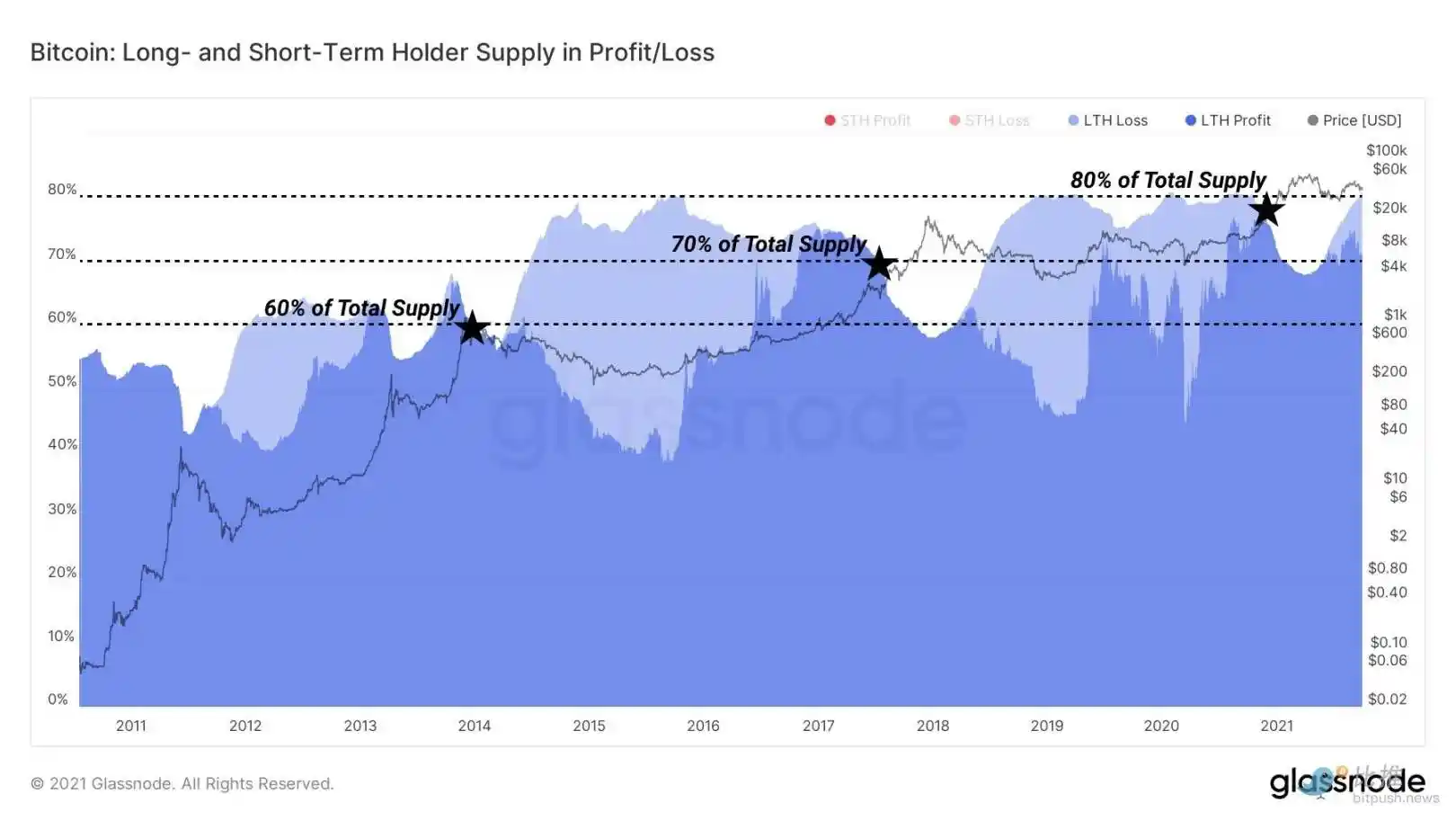
Chart Source: studio.glassnode.com
What the Chart Reveals
On the Ethereum weekly chart, the trend shows striking similarity. In July 2019, shortly after the end of QT, Ethereum tested its 20-week moving average, bounced back, retested it, and only truly recovered months later.
This summer, the same 20-50 week moving average crossover is once again playing out; this serves as a reminder that the market cycle always oscillates between hope and exhaustion.
Gambardello explained that the key signal to watch for would be whether Ethereum can break above the 20-week moving average. This is a short-term confirmation signal to assess if the market is set to mirror the 2019 trajectory.
Otherwise, the total market cap temporarily dropping to the $3 trillion range (compared to the current $3.6 trillion displayed on CoinMarketCap) could replay the script from that year: a dip sufficient to scare off retail investors, yet not enough to end the upward trend.
A Different Decade, Same Market Psychology
Of course, 2025 is not a mere replication of 2019. The headlines in crypto news have changed, and there have been significant macro shifts.
A crypto-friendly U.S. government is now in power. The CLEAR Act and the GENIUS Act have essentially put an end to the regulatory uncertainty that used to keep investors up at night. Ethereum ETFs are now trading.
Stablecoin issuers are under regulation. BlackRock now sits atop the throne of $250 billion in crypto ETF assets.
This institutional force will not vanish overnight. Instead, it has altered the market's rhythm, transforming the adrenaline-fueled market into a domain managed by spreadsheets and stress tests.
What we may be witnessing is not another bull or bear market, but rather a more nuanced shift: a transitional phase within a larger monetary climate system.
The Federal Reserve's liquidity pivot, the inauguration of a new chair in May, and regulatory normalization might collectively make 2025 a period of quiet preparation before the next upswing.
Gambardello doesn't believe we are entering a bear market, but rather a "frustrating consolidation phase".
Yes, it's frustrating. But perhaps it's necessary. If the 2019 crypto market taught us anything, it's that boredom is often the prelude to a breakthrough.
You may also like

Who's at the CFTC Table? A Rebalancing of American Fintech Discourse

AI Trading vs Human Crypto Traders: $10,000 Live Trading Battle Results in Munich, Germany (WEEX Hackathon 2026)
Discover how AI trading outperformed human traders in WEEX's live Munich showdown. Learn 3 key strategies from the battle and why AI is changing crypto trading.

Elon Musk's X Money vs. Crypto's Synthetic Dollars: Who Wins the Future of Money?
How do Synthetic Dollars work? This guide explains their strategies, benefits over traditional stablecoins like USDT, and risks every crypto trader must know.

The Israeli military is hunting a mole on Polymarket

Q4 $667M Net Loss: Coinbase Earnings Report Foreshadows Challenging 2026 for Crypto Industry?

BlackRock Buying UNI, What's the Catch?

Lost in Hong Kong

Gold Plunges Over 4%, Silver Crashes 11%, Stock Market Plummet Triggers Precious Metals Algorithmic Selling Pressure?

Coinbase and Solana make successive moves, Agent economy to become the next big narrative

Aave DAO Wins, But the Game Is Not Over
Coinbase Earnings Call, Latest Developments in Aave Tokenomics Debate, What's Trending in the Global Crypto Community Today?
ICE, the parent company of the NYSE, Goes All In: Index Futures Contracts and Sentiment Prediction Market Tool

On-Chain Options: The Crossroads of DeFi Miners and Traders

How WEEX and LALIGA Redefine Elite Performance
WEEX x LALIGA partnership: Where trading discipline meets football excellence. Discover how WEEX, official regional partner in Hong Kong & Taiwan, brings crypto and sports fans together through shared values of strategy, control, and long-term performance.

Best Crypto to Buy Now February 10 – XRP, Solana, Dogecoin
Key Takeaways XRP is set to revolutionize cross-border transactions, potentially reaching $5 by the end of Q2 with…
Kyle Samani Criticizes Hyperliquid in Explosive Post-Departure Market Commentary
Key Takeaways: Kyle Samani, former co-founder of Multicoin Capital, publicly criticizes Hyperliquid, labeling it a systemic risk. Samani’s…
Leading AI Claude Forecasts the Price of XRP, Cardano, and Ethereum by the End of 2026
Key Takeaways: XRP’s value is projected to reach $8 by 2026 due to major institutional adoption. Cardano (ADA)…
Bitcoin Price Prediction: Alarming New Research Cautions Millions in BTC at Risk of ‘Quantum Freeze’ – Are You Ready?
Key Takeaways Quantum Threat to Bitcoin: The rise of quantum computing presents a unique security challenge to Bitcoin,…
Who's at the CFTC Table? A Rebalancing of American Fintech Discourse
AI Trading vs Human Crypto Traders: $10,000 Live Trading Battle Results in Munich, Germany (WEEX Hackathon 2026)
Discover how AI trading outperformed human traders in WEEX's live Munich showdown. Learn 3 key strategies from the battle and why AI is changing crypto trading.
Elon Musk's X Money vs. Crypto's Synthetic Dollars: Who Wins the Future of Money?
How do Synthetic Dollars work? This guide explains their strategies, benefits over traditional stablecoins like USDT, and risks every crypto trader must know.


 App
App