
- Buy Crypto
- Markets
 Futures
- Spot
- Copy Trade
- Earn
- More
Ethereum Foundation Sets Up a "Dead Man's Switch," Will the Community Buy It?

Original Article Title: "Ethereum Foundation Issues a 'Life-or-Death Promise,' Will the Community Buy It?"
Original Article Author: KarenZ, Foresight News
On the evening of March 13, the Ethereum Foundation (EF) board of directors released a mission statement called the "EF Mandate."
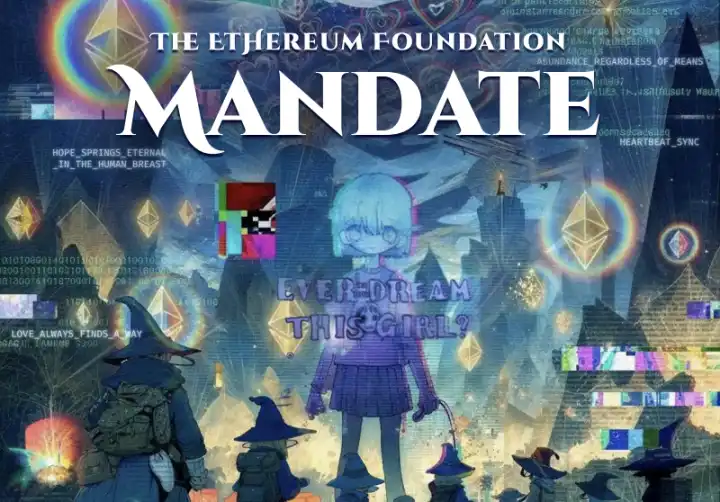
As you unfold this mission statement, you may wonder if you've entered the wrong set—the screen full of stars, elves, wizards, and a layout resembling an anime poster. Beneath this cool outer layer lies the current Ethereum ecosystem's "ideological manifesto."
TL;DR
· EF Core Positioning: Guardians, Not Rulers. EF's ultimate goal is to pass the "Walkaway Test"—even if the Ethereum Foundation dissolves in place tomorrow, the Ethereum network can still function perfectly.
· CROPS Immutable Law is the Baseline: Any technical development must meet Censorship Resistance, Open Source, Privacy, and Security. These four attributes are indispensable, and no development priority can outweigh them.
· EF Working Philosophy: The foundation subtracts so Ethereum can be more resilient. When the ecosystem is mature enough, the Ethereum Foundation will gradually decentralize.
· What Not to Do: Not to be a "kingmaker," not to be a rating agency, not to engage in pump-and-dump marketing, and certainly not to encourage Ethereum's use as a "big casino."
· Ultimate Vision: Looking 1,000 years into the future, providing a "digital sanctuary" free from exploitation by power, capital, AI, or even families.
What Exactly Does Ethereum Aim to Solve?
The EF believes that in the digital age, there are two infrastructural essentials: self-sovereignty—controlling one's own data, identity, and assets—and the ability to collaborate with others without being "choked" by anyone (preservation of sovereignty through coordination).
If you only pursue the first point, running a local app is sufficient; if you only pursue the second point, the traditional internet is adequate. Ethereum's unique value lies in achieving both simultaneously.
A passage in the manifesto states: Ethereum's existence is to ensure that no one can "rug" you—whether it's a government, company, institution, or AI.
Around this goal, EF has proposed an acronym: CROPS. This word appears 32 times in the manifesto.
· Censorship Resistance: No one can stop you from doing legal things; even under pressure, cryptographic neutrality holds.
· Open Source & Free: All code and rules are laid out; there are no hidden black boxes.
· Privacy: Your data belongs to you, not the platform. You decide what information to share with whom.
· Security: Protecting the system and users from technological failures and coercion are paramount.
These four attributes are defined in the document as an "indivisible whole," the highest priority, a baseline that must not be compromised for any reason.
The EF's attitude is clear: They would rather go slower but get these things right from day one because once surrendered, it's almost impossible to get them back.
What Does the Foundation Do? What Doesn't It Do?
The EF is treating "making itself unnecessary" as the ultimate success criterion.
There is a term in the document called the "walkaway test," which means: If EF disappeared tomorrow, could Ethereum keep running and evolving on its own? EF's goal is to make the answer to this question "yes."
Therefore, the EF is following a philosophy of "subtractive development": focusing on key tasks in the ecosystem that no one else can or wants to do—core protocol upgrades, long-term technical research, public security. Once a community in a certain area can take over, the EF hands it off, further reducing its relative influence.
At the same time, the EF has drawn up a long list of "don'ts" for itself, reading like a solemn disclaimer: not a company, not a kingmaker, not a certifying body, not a product studio, not a marketing company, not a boss, not a government agency, not a casino, not an opportunist.
When There Is No Standard Answer, How Will EF Decide?
Many lofty principles have been discussed: CROPS, sovereign individuality, subtractive philosophy. But what to do when faced with specific problems? This chapter is the answer.
It's a bit like the foundation's "decision-making algorithm": When faced with two paths, how do you choose without betraying your original intention?
· When choosing a technical solution, choose the one that "won't bottleneck in the future," even if it's slower now. An example in the document is transaction propagation: one solution performs well but relies on a private relay network (whitelist), while another decentralized solution advances slowly. The EF's answer may be the latter because once the former is implemented, the process of "decentralizing later" is unlikely to occur.
· When designing or evaluating proposals, don't just look at the immediate layer; consider the impact on other layers. Some solutions may seem fine in isolation, even aligning with CROPS principles, but when viewed in the entire ecosystem, they may create new issues elsewhere. Don't solve one problem and create ten more.
· User security is crucial, but don't make decisions for users. Only provide users with tools for self-defense, never impose "paternalistic" restrictions. No one should restrict users under the guise of "protecting users" and undermine users' autonomy. For example, some wallets may default to "security mode," covertly block certain contracts, lead users to specific platforms, or even use opaque AI to determine "risky operations" while secretly collecting user behavior—actions that the foundation opposes. Real protection means giving users verifiable filtering tools, publicly available blacklists/whitelists; regardless of the tool, privacy protection is the default, and AI components are no exception.
· Insistent on having intermediaries? Lower the barriers, leave an exit: If some areas currently cannot operate without intermediaries, then minimize entry barriers, allow full market competition, while ensuring users have an "intermediary-free" alternative that is user-friendly and practical.
· When choosing which teams to support, ignore social glamour and focus on actual technical choices. Many projects claim to follow CROPS, but their actual designs hide closed-source core components, impose whitelist restrictions, and guide users along specific paths—these should be approached with caution.
Ideals are lofty, reality is stark
This manifesto is written with great conviction, but the relentless interrogations of reality never cease.
Does this document represent the consensus of all, or just the ideals of some authors? If the EF undergoes personnel changes, does it still hold? Who will oversee the execution?
The more pressing issues are:
· The EF's operational funds heavily rely on holding ETH assets. If the price of ETH dips, the budget will be compressed. "Not caring about the price" is just a mindset discipline, not a financial reality.
· The CROPS rule is an ideal rule, but the world does not operate on CROPS.
· What most users truly care about is: speed, cost-effectiveness, and user-friendliness.
· The EF insists on being "fully CROPS from day one," but will this cause Ethereum to lag behind more "pragmatic" competitors in terms of user experience and commercialization?
· How is the EF's "do" and "don't do" assessed? How is accountability ensured? How is it judged whether "coordination" is good or not?
Community in Turmoil: Punk Idealism vs. Real-World Disconnect
Less than 24 hours since the manifesto was published, community feedback has already polarized:
Critics:
· Eigen Labs researcher Kydo bluntly stated that the EF's current direction is a 180-degree turn, overturning the previous "pragmatic approach" supporting stablecoins, institutional involvement, and RWAs, marginalizing the currently most marketable applications;
· Forward Ind. Chairman mocked: "They build what they want to build, not what you want"—accusing the EF of only building according to idealism, disregarding community and market demands;
· Hazeflow founder Pavel Paramonov called it "another bunch of ideological nonsense," failing to clarify Ethereum's specific direction going forward.
Supporters:
· Namefi founder Zainan Victor Zhou believes this is a constraint on the EF organization, not a restriction on the entire ecosystem;
· Columbia Business School professor Omid Malekan points out that CROPS is precisely the foundation that makes Ethereum a leader in the financial field—it provides true "access + verifiability + property rights protection."
Facing controversy, Vitalik personally stepped in to clarify: This manifesto "is not surprising to many," and is the direction the EF has been contemplating over the past few months. The EF only acts as Ethereum's steward, leaving the rest to the broader ecosystem—this is the starting point of a new chapter.
To conclude, ending with an Italian phrase: "E quindi uscimmo a riveder le stelle" — from Dante's Divine Comedy - Inferno, literally meaning "And so we came forth, and once again beheld the stars."
The EF also created a "SOURCE SEPPUKU LICENSE" meme, stating: "If the Foundation fails to uphold its solemn promise to Ethereum, let it face the consequences and take responsibility."
The EF likened itself to a traveler through hell, willing to endure the trials and doubts of reality in order to advance towards the "digital freedom" star. Of course, only time will tell.
You may also like

Reduced to a hacker's ATM yet standing tall, the theft of Venus reflects the awkwardness of DeFi

Under geopolitical conflicts, a policy window has opened. Can Hong Kong seize this wave of RWA opportunities?

For Web3, this time Cai Wensheng is determined to get his hands dirty

ConversationArthur Hayes: AI Will Spark Financial Crisis, Wait for Central Bank Money Printing Before Buying Bitcoin

From Power to Chip: How the Average Person Can Participate in the Wealth Opportunities of the AI Era

Venus Exploit Post-Mortem: How to Profit in a Flash Loan Window?

Oil Price Surges, Inflation Rekindled: Will the Fed's Next Move Be a Rate Hike?

The Rise of Crypto Passive Income: How Auto Earn Unlocks the Hidden Value of Idle Crypto
Discover how Auto Earn helps investors turn idle crypto into crypto passive income. Learn why Auto Earn is becoming a popular strategy in the evolving Web3 economy.

Tron Industry Weekly Report: Risk aversion intensifies but Strategy increases BTC holdings, detailed explanation of the Agent payment protocol PAN Network based on x402 and ERC-8004
March 16 Key Market Intel - A Must-See! | Alpha Morning Report

Google's biggest acquisition ever, why Wiz?
「1011 Insider Whale」 Agent Garrett Jin: After the Houthi blockade, who will run out of steam first?

Vitalik Revisits Ethereum Beacon Chain Architecture, Claude's Off-Peak Transaction Limit Doubled, What Are English-Speaking Communities Discussing Today?

$90 Million Black Hole: War, Power, and the Crypto-Tragedy of the Middle East

The price difference exceeds 50%, and the pre-market arbitrage market for cryptocurrency stocks will become a new business in the crypto bear market

How to Trade Crude Oil: Market Volatility Creates New Opportunities for Crypto Traders
Oil prices are back in focus as geopolitical tensions and supply shifts reshape global markets. Learn how crude oil trading works and explore a $30,000 trading campaign on WEEX.

OpenClaw and AI Bots: From AI Trading to BTC Liquidations in the Crypto Gold Rush
AI crypto trading bots like OpenClaw and AI trading apps are reshaping digital markets. From BTC liquidations to crypto bubble charts, automated trading is expanding alongside free crypto airdrops, affiliate programs, LALIGA partnerships, and tokenized gold markets.



 App
App