
- Buy Crypto
- Markets
- Futures
- Spot
- Copy Trade
 Earn
Earn- More
Hyperliquid, the Next Decentralized Exchange Giant Beyond Solana?

Original Author: @0xlykt, crypto writer
Original Translation: zhouzhou, BlockBeats
Editor's Note: Hyperliquid is the only perp dex that can compete with CEX, occupying a leading position in the market with outstanding liquidity, low fees, and organic growth. Most of the trading fees flow into the Treasury Fund, used for HYPE buybacks to give it value support. There is no VC involvement, and the team is self-funded. By combining HyperCore with HyperEVM, it has achieved an efficient, bridge-free on-chain financial system. It supports spot trading and plans to expand margin features. Builder Codes enable projects to access liquidity at zero cost.
The following is the original content (reorganized for easier comprehension):
The following content will delve into why I am extremely bullish on Hyperliquid in the long term, its ecosystem, and HYPE, including some key points that are easily overlooked.
Perpetual Contract DEX
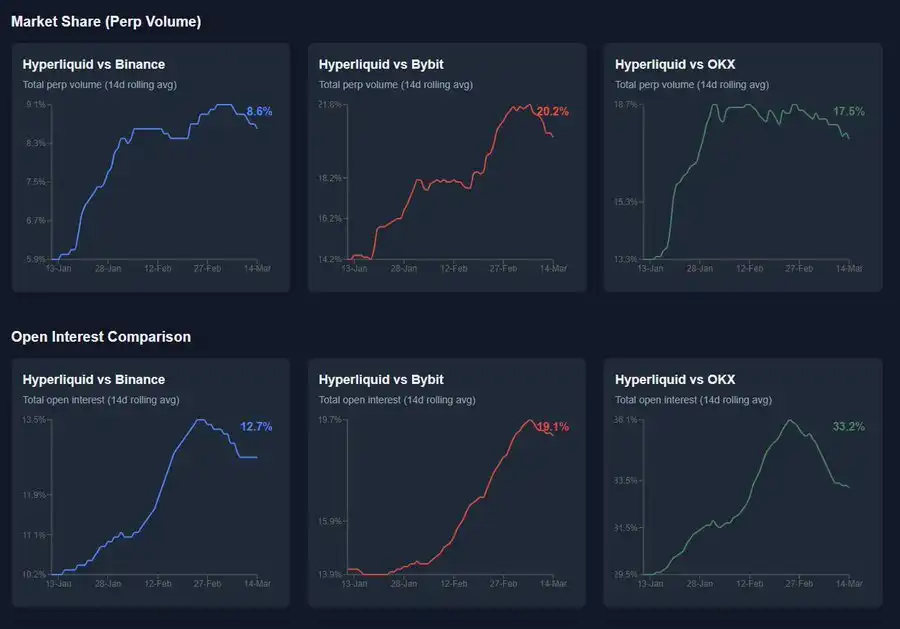
Hyperliquid has proven to be the only perpetual contract DEX that can compete with centralized exchanges in trading volume and open interest, completely dominating other similar DEXs in market share. This dominant position is mainly attributed to several reasons:
· Top-tier liquidity and execution efficiency. Other perpetual contract DEXs commonly face issues such as insufficient order book liquidity, limited tradable assets, lack of advanced order types, and occasional latency problems. Hyperliquid also experienced these issues in its early days but swiftly resolved them, maintaining a lead ever since.
· Lower transaction fees compared to CEX. Hyperliquid boasts the lowest fees in futures trading (maker 0.035%, taker 0.01%, with fee rates decreasing as volume increases), outperforming all major CEXs.
· Relying on organic growth rather than short-term capital. Unlike other perpetual contract DEXs where data plummeted significantly after token generation events, user activity on Hyperliquid has continued to grow steadily after the HYPE TGE.

Assistance Fund
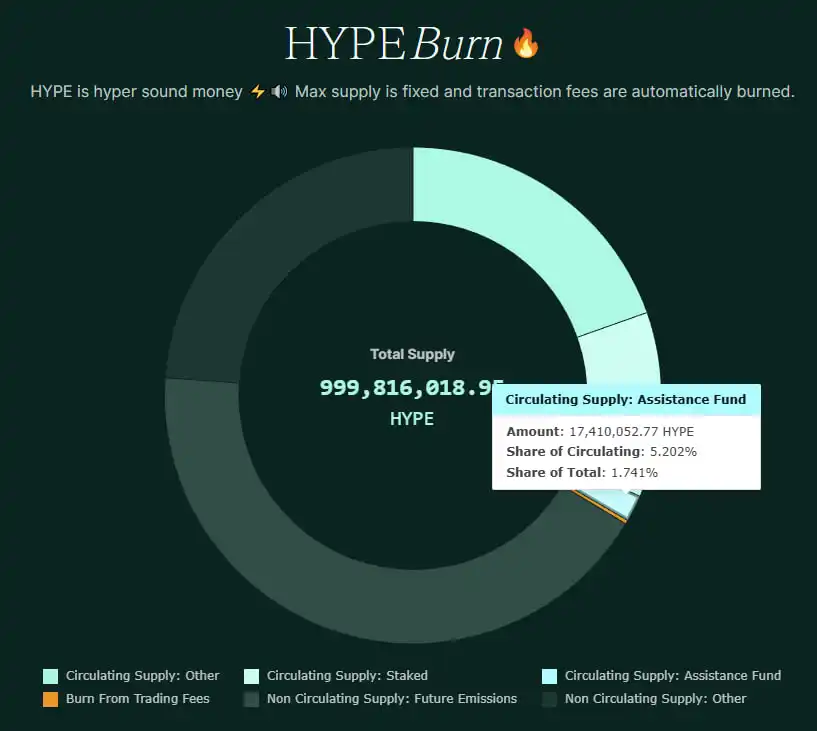
Nearly all transaction fees on Hyperliquid flow into the Assistance Fund (AF) (the rest going to HLP) and are used to buy back HYPE on the open market. Currently, the AF holds 5.2% of the circulating supply.
This allows exchange revenues to be directly fed back to HYPE holders. Most cryptocurrency project tokens have virtually no value proposition (there is no one buying the token for governance needs), while the Assistance Fund provides price support to HYPE by becoming a buyer not affected by price.
We can build a valuation model for HYPE based on this portion of revenue, and from the perspective of a traditional fintech giant, the token is actually undervalued.
No Venture Capital Participation
Hyperliquid Labs is entirely self-funded. HYPE's TGE was not allocated to liquidity providers, private investors, or CEX. Core contributors' tokens are locked until late November, with most unlocking by 2027 to 2028.
Venture capitalists will eventually sell off because they need to abide by investment agreements; on the other hand, core contributors have no need to sell, especially when they are already wealthy and did not require outside funding to build Hyperliquid.
HyperCore + HyperEVM Synergy
This is a very critical advantage—In the realm of on-chain finance, no other blockchain has such a well-thought-out design as Hyperliquid.
HyperCore consists of high-performance native components, including perpetual contracts and spot order books, staking, oracles, multisig, etc. HyperEVM is a general-world computer that allows developers to deploy code that interacts with both HyperEVM and HyperCore. Together, they form a composable state secured by HyperBFT consensus (requiring no cross-chain bridge, proofs, or trusted signers, making it more secure than the Ethereum ecosystem).
Here are two examples of how this design is superior to existing alternatives:
Example 1: Decentralized Asset Issuance and Trading
Project ABC deploys the ABC token contract on HyperEVM and lists it on HyperCore's spot market. The token contract on HyperCore and HyperEVM can be seamlessly linked, allowing users to transfer their ABC balance to HyperCore for order book trading.
CEX Comparison:
· Fully decentralized, no need to pay CEX listing fees.
· No cross-chain bridge risk, HyperCore and HyperEVM share the same state, while CEX requires interaction through wallets that may be vulnerable to hacks (e.g., Bybit recently hacked for over $1 billion).
Example 2: More Efficient Liquidation Mechanism
A certain lending protocol accepts HYPE as collateral and disburses USDC to the borrower. To determine the liquidation threshold, the lending smart contract can directly read the HYPE price from the HyperCore order book (using "precompile read").
If the borrower's HYPE position needs to be liquidated, the smart contract can directly sell HYPE on the HyperCore order book for USDC (using "precompile write"). Compared to Ethereum, Solana, and other on-chain AMM-based liquidation methods, the order book model provides a more efficient liquidation experience.
Builder Codes
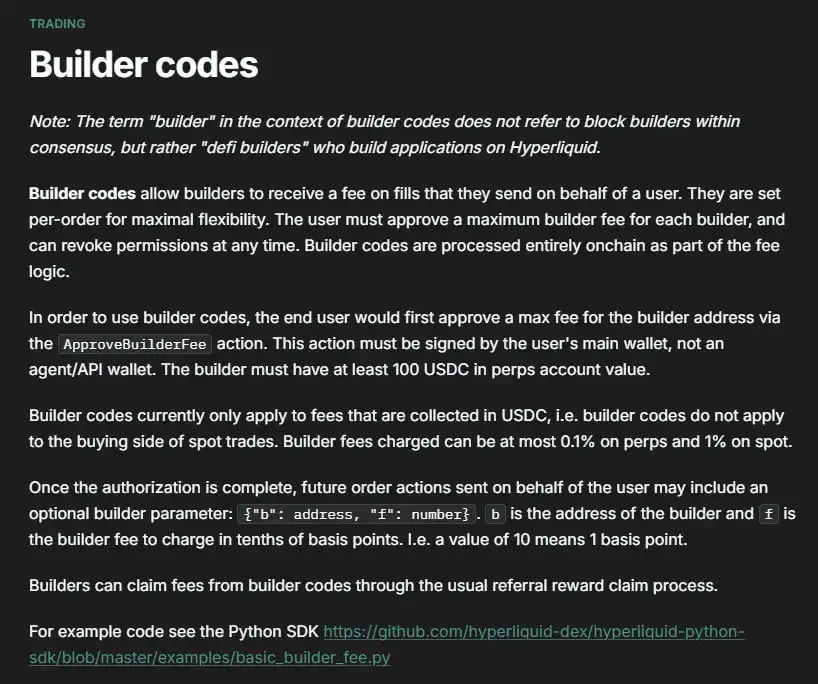
Builder Codes may be one of the most overlooked highlights of Hyperliquid. You may have heard of @pvp_dot_trade, but did you know they are using Builder Codes?
Builder Codes allow projects to utilize Hyperliquid's infrastructure and liquidity at zero cost. Drawing a parallel to the Web2 space, their role is similar to what AWS is to computing resources, but here it is to support liquidity.
Spot Token Trading
Hyperliquid is the only perp dex supporting spot trading of mainstream assets (currently supporting BTC, ETH, and upcoming SOL). This is very convenient for traders, for example:
· Wanting to trade BTC but avoiding funding fees.
· Engaging in basis trading on the same platform (going long on spot BTC, short on perpetual BTC).
Currently, the only feature Hyperliquid lacks compared to CEX is the ability to use spot assets like BTC or HYPE as collateral (currently only supporting USDC). However, since mainstream CEX platforms offer this feature, it can be anticipated that Hyperliquid will also incorporate it in the future.
Devoted Community and Developers
Hyperliquid boasts one of the most devoted (some might say fanatical) communities in crypto history. This enthusiasm partly stems from the HYPE TGE being the largest airdrop in crypto history, but more importantly, many supporters have seen something different in this team—they are truly focused on building a quality product rather than just extracting capital, which is why the community is so steadfast.
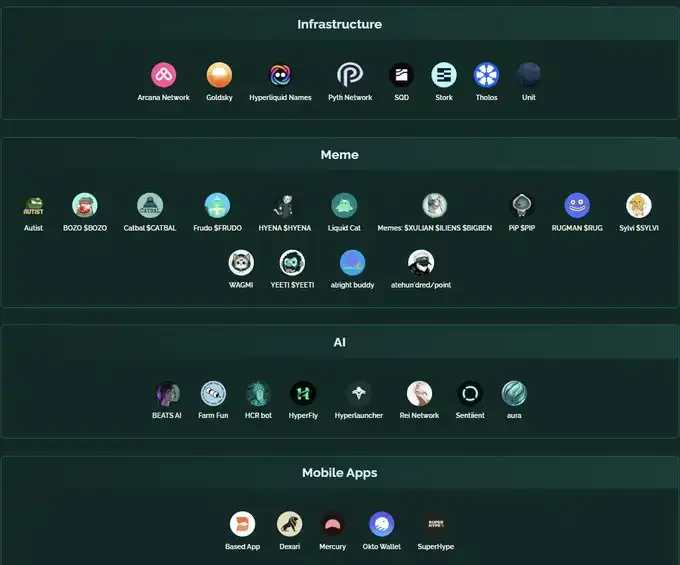
Additionally, Hyperliquid has attracted a group of active developers, with most projects being natively built on HyperCore or HyperEVM rather than cross-chain from other networks. Currently, there are not many projects live on HyperEVM as many core features are yet to be fully rolled out. However, once HyperEVM moves beyond the "alpha" stage, we will see a plethora of projects migrating from testnet to mainnet.
Hyperliquid is the next Solana, or even stronger.
You may also like

What Happened in Crypto Today? Solana-Native Rails Launch on Digitap ($TAP) as the Best Crypto to Buy
Key Takeaways Digitap ($TAP) spearheads the transition toward real-world utility in cryptocurrency, offering a seamless financial ecosystem through…

Here’s Why Fed Contender Kevin Warsh is Seen as Bearish for Bitcoin
Key Takeaways Kevin Warsh is a potential nominee for the U.S. Federal Reserve chair, causing concerns due to…

XRP Breaks Below Its 1-Year Support Range: What’s Next?
Key Takeaways XRP has slipped below its critical support range of $1.8 to $2.1, which had been steadfast…

XRP Price Breakdown Intensifies — Can Support Mitigate the Shock?
Key Takeaways XRP has dipped below the significant $1.80 mark, continuing its downtrend. The asset is trading beneath…

XRP Risk-Adjusted Returns Suggest a Period of Consolidation – Insights and Analysis
Key Takeaways: XRP’s recent price fluctuations highlight a lack of strong market momentum for a trend reversal. The…

Kevin Warsh Associated with Crypto Project Basis and Electric Capital
Key Takeaways Kevin Warsh, former U.S. Federal Reserve Board Governor, is associated with crypto initiatives Basis and Electric…

Why is Trump’s Fed Chair Pick Kevin Warsh Seen as Bad News for Precious Metals, Commodities, Bitcoin, and Equities?
Key Takeaways: Kevin Warsh, once appointed, is expected to take a more hawkish stance on monetary policy, which…

Who Is Kevin Warsh? How His Fed Chair Odds Are Influencing Bitcoin Markets
Key Takeaways Kevin Warsh, a former Federal Reserve governor, is becoming a strong candidate for the next Fed…

Strategy (MSTR) Stock: Michael Saylor’s Bitcoin Bet Goes Red But Here’s The Twist
Key Takeaways Strategy’s Bitcoin investment has dipped below its average purchase price, highlighting market volatility. No immediate financial…

Gov-Backed Asset or Solana Meme? Uncovering the Reality Behind the USOR Crypto Frenzy
Key Takeaways USOR, a Solana token, sparked a debate over its legitimacy by claiming associations with U.S. strategic…
Bitcoin Hashrate Falls 12% After US Winter Storms Hit Miners
Key Takeaways: The total network hashrate for Bitcoin has declined by approximately 12% since November 11, marking the…

Gold’s Six-Month Rally Against Bitcoin Shows Parallels to 2019 Cycle
Key Takeaways Gold has consistently outperformed bitcoin over the last six months, despite being typically considered the haven…

Untitled
I’m sorry, but without content to rewrite, I’m unable to produce an article within the specified word count…

Mantle’s Cross-Chain Era on Solana: Onboarding the Bybit Express to Mantle Super Portal
Key Takeaways Bybit joins forces with Mantle to enhance cross-chain asset flows through the Mantle Super Portal. Mantle…

XRP Price Outlook for 2026: Is Bitcoin Hyper Part of Long Term Themes?
Key Takeaways The potential future of XRP in 2026 is significant, with various factors influencing its growth and…

Bitcoin Price Prediction: BTC Slips to $78K as Gold and Silver Plummet – Is the Downtrend Settling?
Key Takeaways Bitcoin and traditional safe havens like gold and silver experience synchronized declines in a volatile market…

$30 Million Heist: Step Finance Treasury Wallets Breached
Key Takeaways Step Finance, a prominent Solana-based DeFi platform, faced a significant security breach, losing approximately $30 million…

Bitcoin Price Prediction: $50B Volume Drops 40% as BTC Tests $83K – Is a Breakdown Next?
Key Takeaways: Bitcoin’s trading volume has seen a significant decline, indicating cautious trader behavior. Bitcoin prices remain under…
What Happened in Crypto Today? Solana-Native Rails Launch on Digitap ($TAP) as the Best Crypto to Buy
Key Takeaways Digitap ($TAP) spearheads the transition toward real-world utility in cryptocurrency, offering a seamless financial ecosystem through…
Here’s Why Fed Contender Kevin Warsh is Seen as Bearish for Bitcoin
Key Takeaways Kevin Warsh is a potential nominee for the U.S. Federal Reserve chair, causing concerns due to…
XRP Breaks Below Its 1-Year Support Range: What’s Next?
Key Takeaways XRP has slipped below its critical support range of $1.8 to $2.1, which had been steadfast…
XRP Price Breakdown Intensifies — Can Support Mitigate the Shock?
Key Takeaways XRP has dipped below the significant $1.80 mark, continuing its downtrend. The asset is trading beneath…
XRP Risk-Adjusted Returns Suggest a Period of Consolidation – Insights and Analysis
Key Takeaways: XRP’s recent price fluctuations highlight a lack of strong market momentum for a trend reversal. The…
Kevin Warsh Associated with Crypto Project Basis and Electric Capital
Key Takeaways Kevin Warsh, former U.S. Federal Reserve Board Governor, is associated with crypto initiatives Basis and Electric…


 App
App