
- Buy Crypto
- Markets
- Futures
- Spot
- Copy Trade
 Earn
Earn- More
OKX DEX, Caught in the Crossfire: What Does the Future Hold?

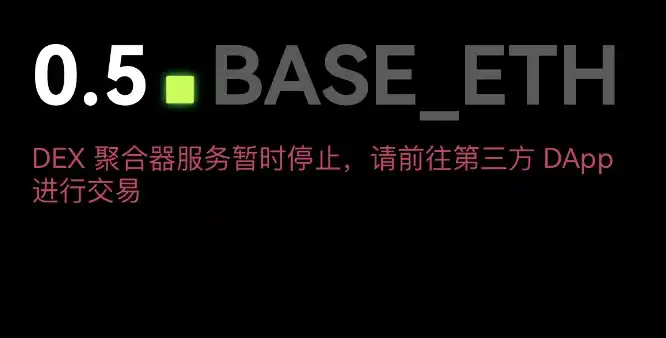
On March 17, OKX officially announced that, after consultation with regulatory authorities, it had voluntarily decided to temporarily suspend its DEX Aggregator service. As a result, related limit orders and cross-chain orders will be automatically canceled. OKX stated that the specific resumption time will depend on the upgrade progress. During this period, users can still trade by redirecting to third-party protocols, while other services of the OKX Web3 wallet remain unaffected.
According to community feedback, some trading bots that have integrated OKX DEX API experienced occasional failures in EVM-based transactions (BSC, ETH).
Meanwhile, Binance Wallet announced that all transactions in the Binance Web3 wallet over the next 6 months will enjoy zero transaction fees. It is evident that a silent war over on-chain products of trading platforms has begun.
Tightening Cryptocurrency Regulation Atmosphere in Europe
At the time of the OKX DEX service suspension, its Web3 service was under scrutiny by European Union regulatory authorities.
On March 11, according to Bloomberg, insiders reported that European cryptocurrency regulators are reviewing the use of a service provided by the crypto exchange OKX, which hackers used to launder $1.5 billion stolen from the exchange platform Bybit. These insiders requested anonymity because the deliberation process is confidential. They said that on March 6, national regulatory authorities from the 27 EU member states discussed this issue at a meeting hosted by the European Securities and Markets Authority's Board of Supervisors of the Digital Finance Commission.
In response, OKX refuted Bloomberg's report, stating that it is a misleading article. As an aggregator, it provides self-custodial wallet services/exchange functions designed to enhance user efficiency and emphasized that its Web3 wallet service is no different from the services offered by other industry participants. OKX also revealed that after Bybit was hacked, OKX froze related funds from entering CEX and developed new features to prevent hacker addresses from using its DEX or wallet services.
OKX firmly stated that it is not under investigation, and the event serves as an example of Bybit's lack of security knowledge. In today's announcement of OKX's temporary suspension of DEX services, this possibility is indicated as being due to "service upgrades."
The regulatory pressure OKX is facing is not unfounded. Globally, the cryptocurrency industry is facing an increasingly strict regulatory environment. François Villeroy, the Governor of the Bank of France, publicly stated on March 17 that the U.S.'s embrace of cryptocurrency could trigger another financial crisis, noting that "financial crises often start in the United States and then spread to other parts of the world. By promoting cryptocurrency and non-bank finance, the U.S. government is sowing the seeds of future turmoil."
On the same day, European Central Bank board member Villeroy de Galhau, in an interview with the French newspaper Le Journal du Dimanche, said, "By encouraging the development of crypto assets and non-bank finance, the US government is sowing the seeds of future turmoil."
It can be said that the regulatory environment for crypto in the European region has always been under pressure. Currently, only OKX and Crypto.com have obtained the EU's Markets in Crypto-Assets Regulation (MiCA) license, both based in Malta. Many exchanges, including Binance, Bybit, and Kraken, are still in the application process.
Tornado Cash Founder Arrested, Thorchain Leader Dismissed, DeFi and Regulatory Struggles Never Stop
OKX is under investigation due to the Bybit hacker transferring funds, a situation that echoes previous events involving Tornado Cash, Thorchain, and hacker fund transfers and money laundering under regulatory pressure.
In April 2023, the US Department of the Treasury released an assessment report on illegal financial activities in DeFi. This report revealed potential risks in DeFi services and analyzed how bad actors exploit these services for criminal activities. Three months later, four US senators introduced the Crypto Assets National Security Enforcement Act, also aiming to strengthen regulations in the KYC, AML, and DeFi fields.
The Crypto Assets National Security Enforcement Act provides a new framework for regulating DeFi. It requires DeFi regulation to be similar to regulating other cryptocurrency institutions, requiring anyone who can control the project to be responsible for it. The bill may mention that if there is no specific person who can control the DeFi service, then any investor who invests more than $250,000 in the project should be responsible for it.
In August 2023, the US Department of the Treasury's Office of Foreign Assets Control sanctioned Roman Semenov, one of the three founders of the Tornado Cash cryptocurrency mixer, for providing substantial support to the nation-state hacker group Lazarus Group, concealing hundreds of millions of dollars in virtual currency theft. In May 2024, a Dutch judge ruled that Alexey Pertsev was guilty of money laundering and sentenced Pertsev to 64 months in prison.
The theft involving Bybit not only affected OKX DEX but also another DeFi protocol, THORChain. The primary money laundering method for the Bybit hacker was through THORChain converting ETH to BTC, bringing a massive amount of trading volume and transaction fees to THORChain. On February 27, according to Cinder, the Bybit hacker's money laundering had brought THORChain $29.1 billion in trading volume and $3 million in transaction fee income in a short time.
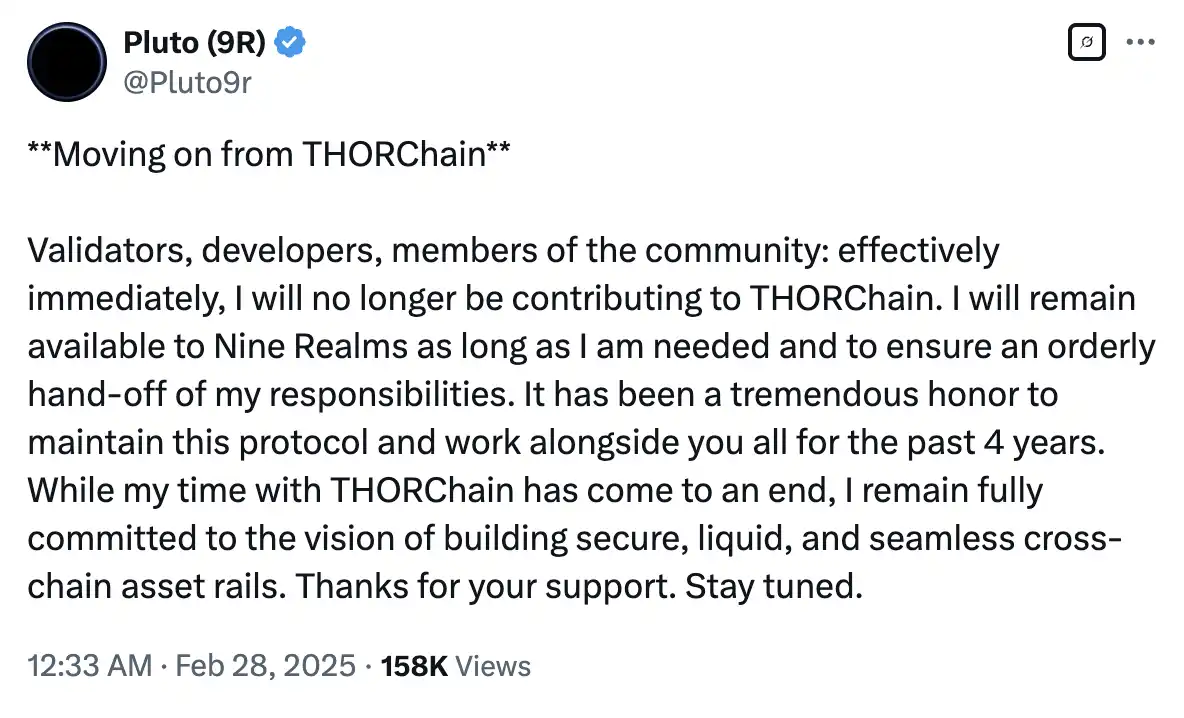
On February 28, THORChain's Chief Developer, Pluto, announced his departure. It is hard to say whether this is related to the hacker using THORChain to transfer funds. This also has nothing to do with the DeFi protocol requirement advocated by the "Cryptocurrency Enforcement for Suspected Transnational Organized Crime Act," which mandates that any individuals who can control the project be responsible for the project.
These cases related to protocol and regulation bring us back to the classic question — if someone uses a kitchen knife to harm others, is the person who sold the knife also guilty?
Prior to this, Wang Xin, the founder of the now-defunct platform Kuaibo, which was infamous for spreading explicit content, appeared on BlockBeats Space. He stated that as a product gains more and more attention, the social responsibility of developers also increases. He believes that developers should proactively embrace regulation and establish preventive mechanisms in advance. The "Kitchen Knife Argument" and "Matchstick Argument" seem more like defenses for developers, presenting a relatively neutral "Car Argument."
The automobile industry has developed over many years. Initially, only racers and enthusiasts used cars, and speed was the focus. But today, cars have become ubiquitous, and besides improving speed, automakers have also done a lot of other work, such as focusing on safety as cars can't run too fast. From an engine performance perspective, cars can reach speeds of over 300 kilometers per hour, but in reality, many cars do not exceed that. Automakers impose these restrictions to prevent accidents caused by speeding. The "Car Argument" is more realistic, emphasizing that developers need to make design decisions in advance and embrace regulation to address more real-world issues.
Perhaps from this perspective, we can understand why OKX chose to pause its DEX services for a service upgrade.
How Does the Community View This?
As the largest and most important wallet gateway for on-chain active users, OKX's DEX service suspension has sparked widespread discussion in the community.
Some believe that acquiring a license is not a one-time accomplishment, and one must continue to comply with licensing requirements, facing significant compliance pressure. In the future, there may be a possibility of separating the Web3 business under the MiCA license. Meanwhile, regarding licenses, some crypto enthusiasts point out that obtaining a license only signifies two deterministic things: 1. You are willing to accept regulation; 2. Your compliance costs have significantly increased.
According to insider revelations, major exchanges are currently undergoing reforms to address regulatory concerns, primarily including splitting wallet apps into separate apps, no longer integrating DEX and cross-chain functionalities in wallet apps, and no longer offering CeDeFi-based official financial products. The issuance and operation entities are completely separated from the trading platform.

After Trump took office, his pro-crypto administration successively revoked the previous SEC's accusations against crypto companies such as Coinbase, Uniswap, Ripple, etc., and the U.S. crypto regulatory environment also became a booster for market sentiment. Therefore, the community optimistically believes that the EU's regulatory action against OKX will also be relaxed.
Furthermore, the community speculates that the most likely scenario is that OKX will split its DEX and CEX business and, following the example of Binance's Web3 wallet, perform user KYC, which is a viable strategy in the direction of compliance.
You may also like

Trump Says He Was Unaware of $500M UAE Investment in World Liberty Financial
Key Takeaways: US President Donald Trump denied knowledge of a $500 million UAE investment in World Liberty Financial.…

Crypto Industry and Banks at a Stalemate Over Stablecoin Yield Deal
Key Takeaways The White House has urged a compromise on stablecoin yields to progress Senate crypto legislation. Crypto…

Why Vitalik Buterin Sold Over 700 Ethereum (ETH) Despite Market Recovery
Key Takeaways Vitalik Buterin sold over 700 Ethereum not for market reasons but to finance long-term projects. The…

Binance Withdrawals Restored Following Temporary Disruption
Key Takeaways Binance faced technical difficulties affecting withdrawals, but services were quickly restored within 20 minutes. The disruption…

Asian Markets Stabilize as Bitcoin Trades Around $78K
Key Takeaways Bitcoin steadies at approximately $78,000 as Asian markets recover from recent volatility. Regional equities, including Japan’s…

Bitcoin Price Prediction: The Warsh Shock & The Stablecoin Summit—Is the Bull Case Dead?
Key Takeaways Kevin Warsh’s nomination as Federal Reserve Chair has caused a drop in liquidity for riskier assets,…

White House Continues to Negotiate Over Crypto Market Structure Bill
Key Takeaways The White House is pushing for a compromise on the contentious issue of stablecoin yields in…
Billionaire Michael Saylor’s Strategy Acquires $75M More Bitcoin – Is This a Bullish Sign?
Key Takeaways Michael Saylor’s Strategy has expanded its Bitcoin holdings by purchasing an additional 855 BTC for $75.3…
Polymarket Bettors Assign Over 70% Probability of Bitcoin Dropping Below $65K — Are They Correct?
Key Takeaways Polymarket users predict Bitcoin has a 71% chance of falling below $65,000 in 2026, reflecting market…
CFTC Regulatory Shift Could Unlock New Growth for Coinbase Prediction Markets
Key Takeaways Newly appointed CFTC Chair, Michael Selig, aims for a unified federal oversight approach for crypto-linked prediction…

We Hacked Perplexity AI to Predict the Price of XRP, Bitcoin, and Ethereum By the End of 2026
Key Takeaways Perplexity AI predicts XRP may soar to $8 by 2026, fueled by legal victories and supportive…
Current Crypto Price Predictions: An In-Depth Analysis of XRP, Dogecoin, and Shiba Inu
Key Takeaways XRP, Dogecoin, and Shiba Inu are experiencing significant price declines amid geopolitical uncertainties and general market…

Pepe Coin Forecast: Price Appears Dismal, Yet Savvy Investors Rally Behind the Scenes
Key Takeaways Pepe Coin has experienced significant price drops, yet indicators suggest it may soon bottom out, with…

BitMine Reports 4.285M ETH Holdings, Expands Staked Position With Massive Reward Outlook
Key Takeaways BitMine Immersion Technologies has reported significant crypto holdings valued at $10.7 billion. The company’s Ethereum holdings…

Crypto Exchanges’ Stock Plunge 60% as Trading Volumes Dwindle – Is the Decline Ending or Just Beginning?
Key Takeaways Trading volumes on major crypto exchanges have drastically fallen, with a nearly 90% drop from October…

Best Crypto to Acquire Now February 2 – XRP, Solana, Ethereum
Key Takeaways Recent market turmoil saw Bitcoin plunge dramatically, affecting all major cryptocurrencies. XRP, Solana, and Ethereum are…

Ethereum Price Prediction: Top ETH Bulls Face $7.6 Billion in Paper Losses as Price Drops Below $2,400
Key Takeaways Ethereum has faced a downturn, dropping 19% below $2,400, resulting in significant paper losses for major…

Shiba Inu Price Prediction: SHIB Just Crashed to a 3-Year Low – Is SHIB Heading Towards Zero?
Key Takeaways Shiba Inu has recently hit a significant low, experiencing a 15% drop that places it at…
Trump Says He Was Unaware of $500M UAE Investment in World Liberty Financial
Key Takeaways: US President Donald Trump denied knowledge of a $500 million UAE investment in World Liberty Financial.…
Crypto Industry and Banks at a Stalemate Over Stablecoin Yield Deal
Key Takeaways The White House has urged a compromise on stablecoin yields to progress Senate crypto legislation. Crypto…
Why Vitalik Buterin Sold Over 700 Ethereum (ETH) Despite Market Recovery
Key Takeaways Vitalik Buterin sold over 700 Ethereum not for market reasons but to finance long-term projects. The…
Binance Withdrawals Restored Following Temporary Disruption
Key Takeaways Binance faced technical difficulties affecting withdrawals, but services were quickly restored within 20 minutes. The disruption…
Asian Markets Stabilize as Bitcoin Trades Around $78K
Key Takeaways Bitcoin steadies at approximately $78,000 as Asian markets recover from recent volatility. Regional equities, including Japan’s…
Bitcoin Price Prediction: The Warsh Shock & The Stablecoin Summit—Is the Bull Case Dead?
Key Takeaways Kevin Warsh’s nomination as Federal Reserve Chair has caused a drop in liquidity for riskier assets,…


 App
App