
 Buy Crypto
- Markets
 Futures
- Spot
- Copy Trade
- Earn
- More
The Growth Trap of Base: Why Everything is Done Right, But Users Still Leave?

Original Article Title: The Base Residency Problem
Original Article Author: Thejaswini M A, Token Dispatch
Original Article Translation: Chopper, Foresight News
A few days ago, I came across a concept in Japanese philosophy: basho. Roughly translated as "place," but philosopher Nishida Kitaro gave it a meaning far beyond just a geographic location, more like a situation: a field where everything can become itself. In other words, a person does not just happen to be somewhere, but is shaped by the place they are in. Today, I am going to use this theory to interpret Base.
Last month, its active addresses dropped to an 18-month low. Reflecting on this phenomenon, I realized that Base has only built a location, but has never created the conditions for things to grow and develop.
In 2023, when Coinbase introduced Base, the crypto-native community surprisingly developed a kind of faith. Everyone believed that it could finally solve Ethereum's oldest problem: abundant infrastructure but no real users. And with Coinbase holding 100 million users and unparalleled distribution capabilities, this was a unique advantage. As soon as the door opened, users were already waiting outside.
For a while, this confidence seemed to be validated. Base's growth rate outpaced all previous Layer 2 solutions. In October 2025, its tvl-7532">total value locked (TVL) reached $5.6 billion, and its fee revenue was unmatched in the entire L2 space. Therefore, in September 2025, Base confirmed the token issuance, as if foreshadowing an inevitably successful experiment. Yes, a place was turning into a field (basho).
Then, the users left.
A closer look at the data: Base's active addresses returned to the levels of July 2024. The token issuance perfectly met the needs of the airdrop community: get the final reward, then leave.
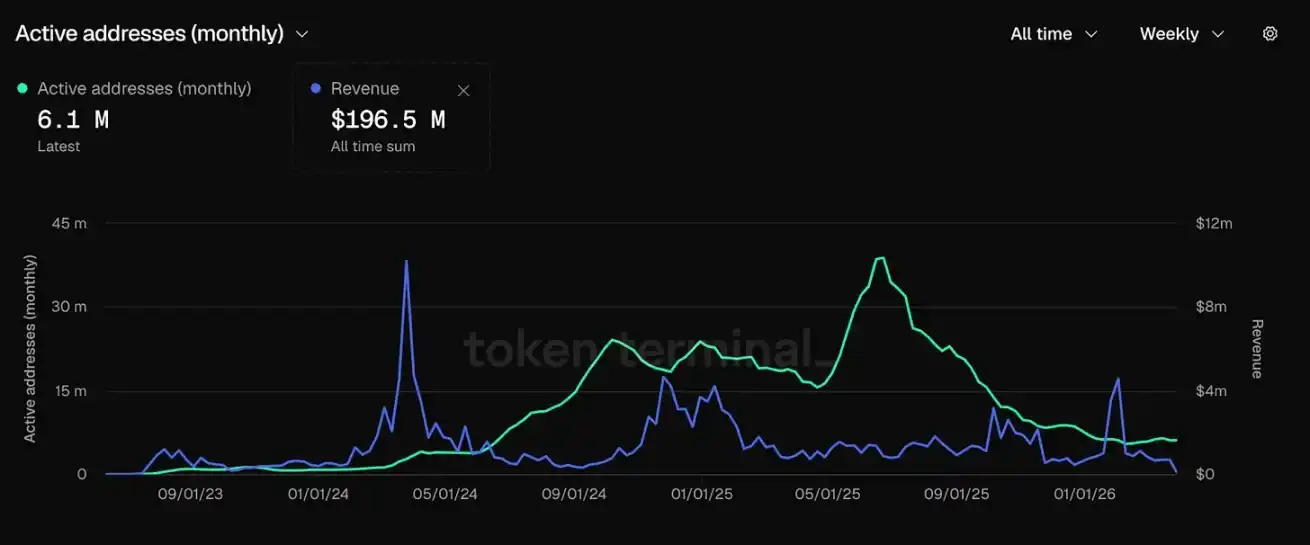
Base's bet on the creator economy in 2025 also did not pay off. Its core was the Zora protocol, which defaults to tokenizing content. By the end of the year, Base had issued 6.52 million creator and content tokens through Zora, of which only 17,800 remained active throughout the year, accounting for 0.3%. The remaining 99.7% received no attention.
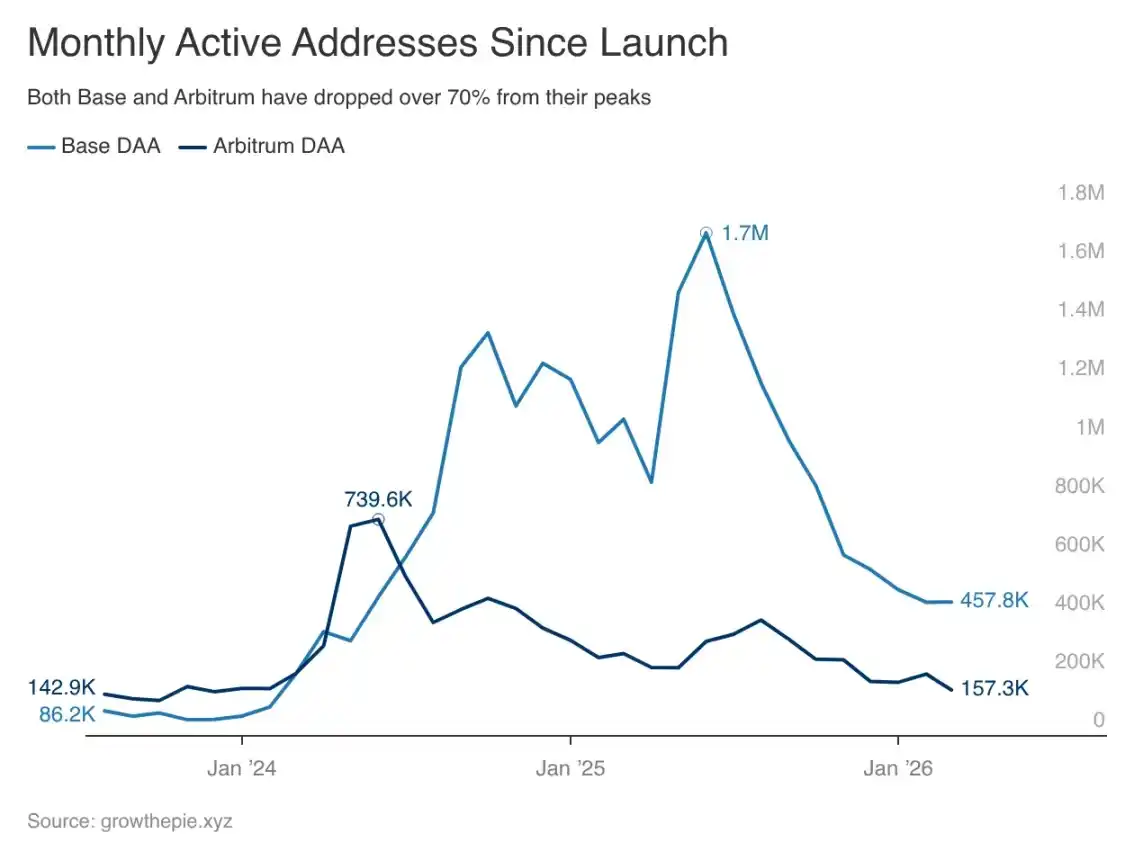
The peak daily active addresses for Base reached 1.72 million in June 2025. By March 2026, only 458,000 remained, a sharp 73% drop from the peak. Following Armstrong's announcement in September 2025 that Base was considering issuing a coin, active addresses dropped by 54% in just six months, signaling a complete exit of speculative funds.
Sociologist Ray Oldenburg once studied: what makes people repeatedly return to a place without any reward. He called it the third place, such as a bar, a barbershop, a city square. They are not efficient production spaces, yet they provide a reason for return unrelated to incentive. The core insight is: the desire to return cannot be artificially produced; it can only organically emerge from the possibilities the place has long provided. The purpose of designing spaces in the cryptocurrency industry is to extract from users, then wonder why no one stays.
This is a place with no "basho": people pass through, take what they need, and leave because there is no cost to leaving. Identity does not form here, there is no ability to establish something unique within three weeks elsewhere, nothing that makes leaving a loss. Does a unique relationship exist on this chain? We have never built anything with this in mind, have we?
You cannot build a place (basho) with financial incentives. Incentives can certainly get people in the door, but they cannot make people want to stay. The desire to stay must come from the long-incubated possibilities of the place. Kitaro Nishida called it "topology of place," referring to how the relational field shapes what emerges within it. The crypto industry designed spaces for extraction and was surprised to find only extraction emerged.
Brian Armstrong publicly stated that the Base App is now focused on becoming Coinbase's self-custody, trading version.
The vision that once aimed to build social stickiness, allowing users to establish on-chain identities worth preserving through social and creator visions, has vanished. From the data, it appears to be a rational decision, yet it acknowledges: This vision never truly materialized. Base had a place, and it is now solely focused on serving its existing users because that is all it can provide.
One Chain, One Track
Base is the epitome of the entire L2 pattern.
Since June 2025, the overall usage of mid-to-small L2 solutions has decreased by 61%. Most chains outside of the top three have become zombie chains: active enough to not shut down but quiet enough to be insignificant. The ratio of daily active users on L2 relative to L1, which was 15x in mid-2024, has now dropped to 10–11x. Most new L2 solutions see a direct collapse in usage after the incentive period ends. The entire L2 ecosystem is cooling off, not just Base.
The Rollup-centric roadmap was once a set of user adoption theories: Lowering the Barrier → User Onboarding → Ecosystem Formation → Network Effect Growth. This year, the Ethereum Foundation released a 38-page vision document outlining Ethereum's future direction. While the largest L2 saw activity bottom out and depart from the OP Stack, the second largest L2 experienced stalled growth.
Reducing the entry cost does not equate to creating the conditions for things to take shape. The industry solved the "onboarding" issue but assumed that a sense of "belonging" would naturally follow. It does not emerge automatically because a sense of belonging is not a feature that can be onboarded.
Farcaster is the crypto world's closest product to constructing an outing (basho). This is because a specific group of people has built a specific culture on it: developers sharing work, discussing Ethereum, forming opinions of each other over months. This takes time, and competitors cannot replicate it with higher rewards. Friend.tech tried to do the same thing with incentive mechanisms, peaking in a week and vanishing in a month. The same mechanism did not cultivate a culture. The difference lies not in the product but in whether someone stays long enough to truly shape something.
What Keeps People Around?
In retaining users during a crypto winter, reliance does not lie in more generous incentives.
Arbitrum reached a peak of 740,000 daily active addresses in June 2024; now, it's at 157,000, a similarly drastic 79% decline. Both chains are sliding, but the underlying logic is completely different.
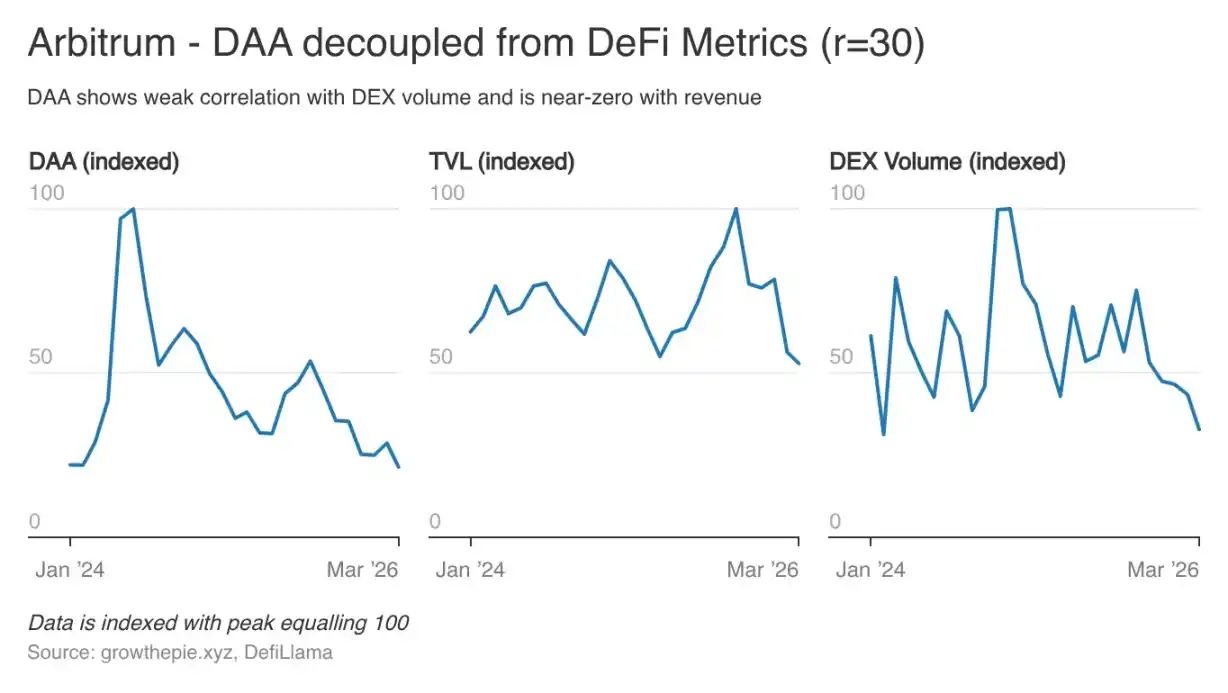
Base users come online for trading, and when trading volume decreases, they leave. In contrast, Arbitrum users are not affected by fee levels; the correlation between user count and fee revenue is almost zero. Base attracts tourists, while Arbitrum somehow retains users.
Hyperliquid stands its ground because of its unique trading experience; the community has formed an identity that is absent elsewhere. Token incentives are almost irrelevant; being part of it has become a part of their behavior and identity. Things shape users, and users, in turn, shape things.
The crypto industry is still optimizing "how to attract people," while the question of "how to create an environment" is only remembered after a data crash and is never considered at the inception of chain design.
I believe that Base has the strongest distribution capability in history, which could have better addressed this issue than any other chain.
Today it is a transaction app. This is a reasonable product direction, but it is also something that more than 40 products have been doing for a long time. Transaction apps cannot create a scene (basho); they can only create a session: users come in when they have a transaction need, complete it, and leave.
To truly become a successful app, you need to establish a continuous connection. Users need to build a relationship between each visit, so that the next visit feels like a return, not just an arrival.
Armstrong's transformation is largely based on the lessons Base learned from the data. The social layer, creator economy, on-chain identity—all of these things that should have turned Base from something “used” to something “resided in” require patience, and the system does not reward patience.
The Ethereum ecosystem needs Base to be more than just a transaction venue. The foundation of the entire L2 narrative is that the chain can become the infrastructure around which people build their lives. If the L2 with the strongest distribution capability in crypto history ultimately settles for being a faster Coinbase, then the narrative itself does not hold up.
Nishida Kadomaro believes that the deepest basho is where the boundary between self and place begins to blur. You cannot completely separate “who you are” from “where you are shaped.” This may sound abstract, but on a public chain, it means that a user cannot imagine their financial life after leaving a certain chain; a developer's entire toolkit is based on an ecosystem; their identity can hardly exist elsewhere.
As far as I know, such a thing has never been built on any L2. It may simply be impossible to build under an incentive scheme.
Even if you have 100 million potential users, if there is nothing worth staying for, it will still end up deserted. Base understands this now.
You may also like

Dialogue with the founder of Pantera: Bitcoin has reached escape velocity, traditional assets are being left behind

The growth dilemma of Base: everything was done right, yet users still leave

Predicting the World Cup "Showdown": Over 150 projects are gearing up, with a total investment of nearly 6 billion dollars

RootData launches the "A-Level Transparency Project Briefing," directly reaching the cryptocurrency listing decision-making chain

What does DeFi look like that Wall Street wants?

Drift Protocol Hack: Understanding One of the Largest Solana Ecosystem Breaches
Key Takeaways Drift Protocol, a decentralized exchange on Solana, experienced a $270 million hack, making it one of…

Navigating the Drift Protocol Security Incident: What You Need to Know
Key Takeaways On April 2, Drift Protocol experienced a security breach where a malicious actor gained administrative control.…
Upbit and Bithumb Designate DRIFT as a Trading Alert Item
Key Takeaways Upbit and Bithumb have labeled DRIFT as a “trading alert” asset following guidance from the Digital…

“Brother Maji” Faces Potential Liquidation with ETH Long Position
Key Takeaways “Brother Maji” currently holds a substantial 25x leveraged long position of 6,000 ETH. The position was…

Wormhole’s Response to Drift Protocol Incident: Delays in Cross-Chain Transfers
Key Takeaways Wormhole confirmed that user assets remain safe despite the Drift Protocol attack. The Solana ecosystem’s built-in…

Bitget Launchpool and MEZO: Navigating the Crypto Reward Opportunities
Key Takeaways Bitget Launchpool offers a way to earn tokens like MEZO by staking assets. The current MEZO…

XRP Price Prediction: Could Ripple Transform into a National Bank?
Key Takeaways: The OCC’s final rule effective from April 1 disrupts traditional banking, potentially allowing Ripple to emerge…

Ripple XRP Approaches National Bank Status: OCC Rule’s Impact
Key Takeaways: Ripple’s journey to full national trust bank status advanced significantly with the OCC’s new rule on…

Cardano Price Forecast: Is ADA Recovery a Bull Trap?
Key Takeaways: Cardano’s price recovery to $0.27 raises questions about whether this is a genuine trend change or…
BNB Price Prediction: Is Binance’s New Prediction Market a Game-Changer?
Key Takeaways: BNB holds a psychological price level at $614, with bullish momentum fueled by Binance’s prediction market.…
Fed’s Barr Advocates Stringent Stablecoin Oversight Amid Historical Lessons
Key Takeaways: Fed Governor Michael Barr stresses the necessity of rigid stablecoin oversight, referencing historical financial instabilities. The…

Solana Price Prediction: Interactive Brokers Backs SOL, Galaxy Digital Expands Support
Key Takeaways: Solana trades sluggishly at $84, despite backing from Interactive Brokers and Galaxy Digital. Institutional interest positions…
Ethereum Price Forecast: Will ETH Sustain Its Momentum?
Key Takeaways: Ethereum ended March with a 7% gain, vastly outshining Bitcoin’s modest 1% increase. Ethereum showed a…
Dialogue with the founder of Pantera: Bitcoin has reached escape velocity, traditional assets are being left behind
The growth dilemma of Base: everything was done right, yet users still leave
Predicting the World Cup "Showdown": Over 150 projects are gearing up, with a total investment of nearly 6 billion dollars
RootData launches the "A-Level Transparency Project Briefing," directly reaching the cryptocurrency listing decision-making chain
What does DeFi look like that Wall Street wants?
Drift Protocol Hack: Understanding One of the Largest Solana Ecosystem Breaches
Key Takeaways Drift Protocol, a decentralized exchange on Solana, experienced a $270 million hack, making it one of…


 App
App