
 Buy Crypto
- Markets
 Futures
- Spot
- Copy Trade
- Earn
- More
Will Bitcoin ETF Increase Bitcoin Price in 2026?


TL;DR
- Bitcoin ETFs can influence Bitcoin price, but not in the short term
- ETF inflows are widely used as signals of institutional demand strength
- Consistent inflows often support long-term market confidence
- Short-term BTC moves still depend on liquidity and derivatives positioning
- In 2026, ETF adoption remains one of the strongest structural drivers of Bitcoin demand
Why Investors Believe Bitcoin ETFs Can Influence Price
Since Bitcoin ETFs became widely available in major financial markets, they introduced a new channel through which traditional capital can gain exposure to Bitcoin without interacting with crypto infrastructure directly.
This structural change matters because price movements in global markets are often driven not only by retail participation, but by how easily large investors can allocate capital.
Before ETFs existed, institutional exposure to Bitcoin required specialized custody arrangements, internal approval processes, and technical integration. ETFs simplified that process by allowing Bitcoin exposure to be treated more like commodity or index allocation within existing portfolio systems.
As a result, ETF inflows are now widely interpreted as signals of long-term allocation behavior rather than speculative positioning.
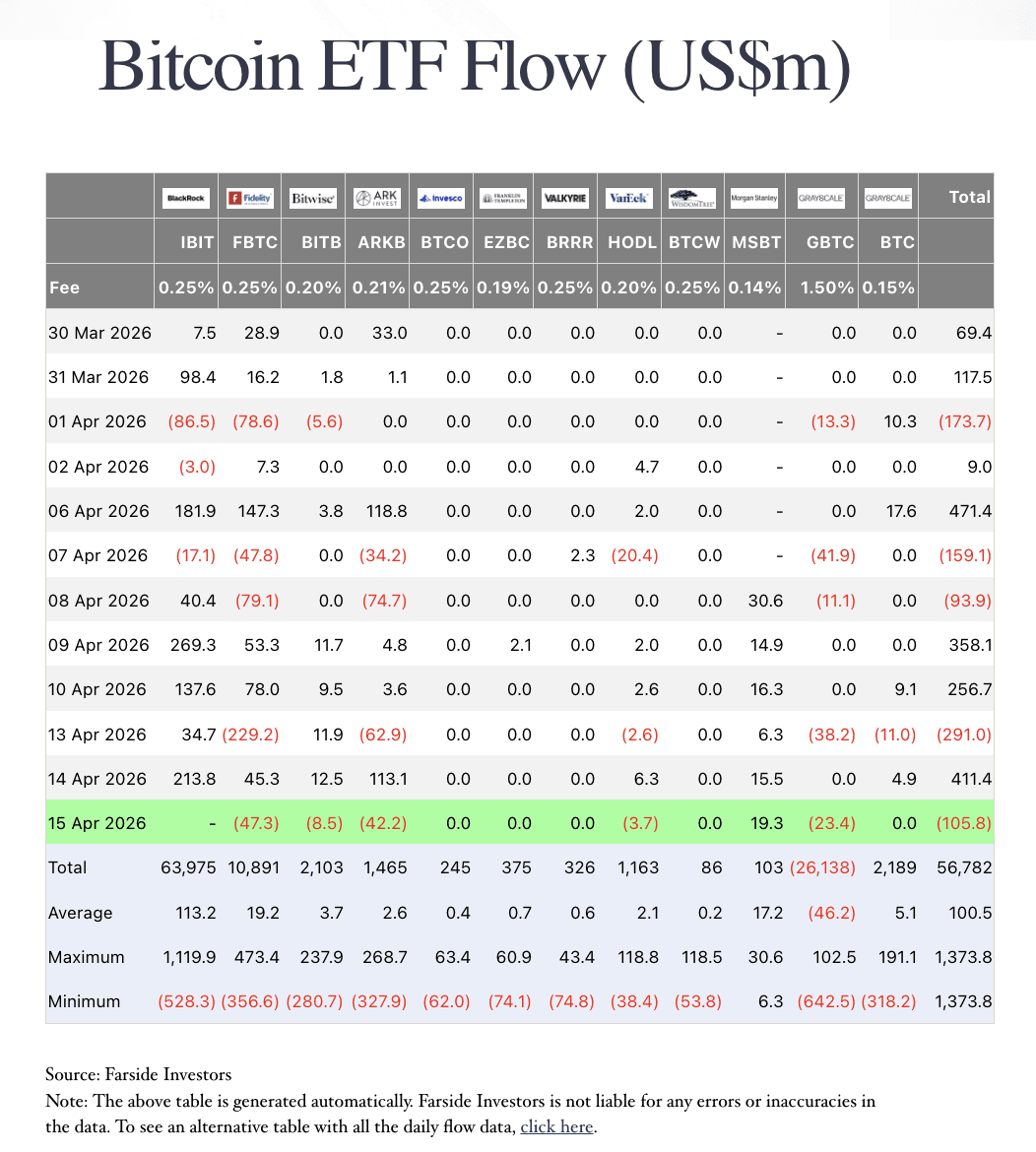
Bitcoin ETF flow data shows how institutional allocation demand enters the market through regulated investment channels. Large positive inflow days—such as April 6 and April 14, 2026—highlight periods when portfolio capital increased exposure to Bitcoin, supporting liquidity conditions even during volatile market environments.
How Bitcoin ETF Inflows Affect Market Structure
Bitcoin ETFs influence price indirectly through liquidity structure rather than through immediate buying pressure alone.
When ETF inflows increase consistently, they typically indicate that portfolio managers are expanding exposure over time. This creates a slower but more stable demand base compared with short-term trading flows.
In contrast to derivatives-driven rallies, ETF-driven demand tends to reflect strategic allocation decisions rather than leverage cycles. Because of this, analysts often view ETF accumulation periods as supportive of long-term price stability rather than short-term volatility spikes.
In 2026, many market participants monitor ETF flow trends alongside on-chain accumulation metrics to understand whether capital entering the market is structural or temporary.
As shown in the chart above, Bitcoin ETF inflows can vary significantly from day to day, but sustained positive flow periods often signal strengthening institutional allocation demand. For example, several trading sessions in early April 2026 recorded net inflows exceeding $300 million per day, demonstrating how ETF channels can introduce large-scale capital into the market within short time windows.
 BTC price movement.png" width="1280" height="588">
As shown in the chart above, spot Bitcoin ETF flows have created a new institutional capital channel into the Bitcoin market. Periods of sustained positive inflows often coincide with strengthening price momentum, suggesting that ETF allocation demand increasingly plays a role in shaping short-term liquidity conditions.
Since the introduction of spot Bitcoin ETFs, capital entering through regulated investment vehicles has become an important component of market participation, reinforcing Bitcoin’s transition from a retail-driven asset toward a more institutionally influenced market structure.
Why ETF Flows Do Not Always Move Bitcoin Immediately
Although ETF inflows are important indicators, they do not guarantee short-term price increases.
Bitcoin price movements remain influenced by multiple factors, including:
global liquidity conditions
macro interest rate expectations
derivatives positioning
miner behavior
long-term holder supply trends
ETF demand interacts with these variables rather than replacing them.
For example, strong ETF inflows during periods of tightening global liquidity may support price resilience without triggering immediate rallies. Conversely, weak inflows during expansionary liquidity environments may reduce upward momentum.
This explains why ETF flows are better interpreted as medium-term positioning signals rather than daily trading indicators.
Why Institutional Allocation Still Matters in 2026
One reason Bitcoin ETFs continue to influence market expectations is their role in long-term portfolio allocation strategies.
Unlike short-term trading flows, institutional allocations are typically gradual and persistent. Portfolio managers often adjust exposure over weeks or months rather than reacting to intraday volatility.
Because of this behavior pattern, ETF inflow trends are often associated with:
improving market confidence
increasing liquidity depth
reduced structural selling pressure
Over time, these changes contribute to a stronger market foundation even when price reactions are not immediate.
What Analysts Watch When Evaluating ETF Impact on Price
Instead of focusing on single-day inflow numbers, analysts usually monitor broader flow patterns across multiple time horizons.
Particular attention is often given to whether ETF inflows:
remain consistent during consolidation periods
increase after volatility events
continue during macro uncertainty
Sustained inflows during uncertain market conditions are often interpreted as signals that institutional investors are treating Bitcoin as a strategic allocation asset rather than a speculative trade.
This shift in perception is one of the reasons ETF activity remains closely watched in 2026.
Can Bitcoin ETF Adoption Support Long-Term Price Growth?
While ETFs alone do not determine Bitcoin's price direction, they change how capital enters the market over time.
By lowering access barriers for traditional investors and integrating Bitcoin exposure into existing portfolio systems, ETFs expand the potential investor base that can participate in the asset class.
This broader accessibility increases the likelihood that Bitcoin becomes part of diversified allocation strategies rather than remaining a niche investment.
For this reason, many analysts view ETF adoption not as a short-term catalyst, but as a structural driver supporting Bitcoin's long-term price trajectory.
About WEEX
Founded in 2018, WEEX has developed into a global crypto exchange with over 6.2 million users across more than 150 countries. The platform emphasizes security, liquidity, and usability, providing over 1,200 spot trading pairs and offering up to 400x leverage in crypto futures trading. In addition to the traditional spot and derivatives markets, WEEX is expanding rapidly in the AI era — delivering real-time AI news, empowering users with AI trading tools, and exploring innovative trade-to-earn models that make intelligent trading more accessible to everyone. Its 1,000 BTC Protection Fund further strengthens asset safety and transparency, while features such as copy trading and advanced trading tools allow users to follow professional traders and experience a more efficient, intelligent trading journey.
Follow WEEX on social media
X: @WEEX_Official
Instagram: @WEEX Exchange
Tiktok: @weex_global
Youtube: @WEEX_Official
Discord: WEEX Community
Telegram: WeexGlobal Group
You may also like

How to Earn Free USDT in 2026: No High Volume Required (WEEX Poker Party Guide)
Is Joker Crypto legit in 2026 or just another memecoin? Can You Really Earn Passive Income with Joker Crypto in 2026? Learn how Joker staking rewards work, how to earn NFT bonuses, expected APY ranges, gas-fee rebates, and how to avoid crypto scams before joining.

How to Get Free USDT Welcome Bonus in 2026: Earn Up to 700 USDT on WEEX
Legit Free Welcome Bonus 2026: Learn how to earn up to 700 USDT on WEEX with Auto Earn Boost Fest. Increase your balance, activate Auto Earn, and qualify automatically.

AI Agent Payments Just Got Real: Utexo × x402 Brings 50ms USDT Transactions to Internet Scale
Utexo integrates USDT into the x402 protocol, enabling 50ms instant payments embedded natively in HTTP requests. Explore how this breakthrough is rewriting the rules for AI agent payments, API monetization, and the machine-to-machine economy.

DWF Deep Report: AI in DeFi Outperforms Humans in Yield Optimization, but Complex Trades Still Lag Behind by 5 Times

What Separates Smart Money from the Crowd in Crypto? Insights from Freedom of Money
Most crypto traders lose money not because of bad luck, but because they misunderstand how the market really works. From Freedom of Money to the rise and fall of Sam Bankman-Fried, they highlight a key divide in crypto: those who build the market and those who chase it. This reading guide explores essential books that reveal how narrative, regulation, capital, and psychology shape long-term success in the crypto industry.

The Risk Management Core Team has just been ousted, and Aave is now facing a $200 million default.

The $293 million bug wasn't in the code; so, what's the deal with the "DVN Configuration Bug," which led to the largest hack of 2026?

a16z on Recruitment: How to Choose Between Crypto-Native and Traditional Talent?

The biggest DeFi heist of 2026, hackers easily took advantage of Aave

Will Robots Replace Humans? He Says No!

Binance Coin's Price Skyrockets 15x to All-Time High, Saved by Three Bull Market Lifelines

The organization has accessed the prediction market, but is stuck at the third stage

Head of crypto VC collective shrinks: a16z crypto fund management scale plummets by 40%, Multicoin cut in half

Arthur Hayes New Post: It's "No Trade" Time Now
Claude Opus 4.7 Review: Is It Worthy of the Title of Strongest Model?

DWF In-Depth Report: AI Outperforms Humans in Yield Farming Optimization in DeFi, But Complex Transactions Still Lag Behind 5x
The financial tricks of the crypto giant Kraken

When proactive market makers start to take initiative
How to Earn Free USDT in 2026: No High Volume Required (WEEX Poker Party Guide)
Is Joker Crypto legit in 2026 or just another memecoin? Can You Really Earn Passive Income with Joker Crypto in 2026? Learn how Joker staking rewards work, how to earn NFT bonuses, expected APY ranges, gas-fee rebates, and how to avoid crypto scams before joining.
How to Get Free USDT Welcome Bonus in 2026: Earn Up to 700 USDT on WEEX
Legit Free Welcome Bonus 2026: Learn how to earn up to 700 USDT on WEEX with Auto Earn Boost Fest. Increase your balance, activate Auto Earn, and qualify automatically.
AI Agent Payments Just Got Real: Utexo × x402 Brings 50ms USDT Transactions to Internet Scale
Utexo integrates USDT into the x402 protocol, enabling 50ms instant payments embedded natively in HTTP requests. Explore how this breakthrough is rewriting the rules for AI agent payments, API monetization, and the machine-to-machine economy.
DWF Deep Report: AI in DeFi Outperforms Humans in Yield Optimization, but Complex Trades Still Lag Behind by 5 Times
What Separates Smart Money from the Crowd in Crypto? Insights from Freedom of Money
Most crypto traders lose money not because of bad luck, but because they misunderstand how the market really works. From Freedom of Money to the rise and fall of Sam Bankman-Fried, they highlight a key divide in crypto: those who build the market and those who chase it. This reading guide explores essential books that reveal how narrative, regulation, capital, and psychology shape long-term success in the crypto industry.



 App
App